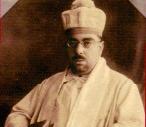
Isaac Algazi (Izmir, 1889 – Montevideo, 1950) was one of the first Jewish singers from the Eastern Mediterranean to issue substantial numbers of commercial recordings starting as early as 1909 and continuing into the late 1920s. His recordings of Jewish religious and non-religious songs, a selection of which are included in this CD, are a precious testimony of the Sephardi Jewish song in the last decades of the Ottoman period. Already in 1938, the Jewish scholar M.D. Gaon noticed that Algazi “was known in all cities of Turkeyand elsewhere as ne'im zemirot Israel [the sweet singer of Israel, an expression used to refer to King David].' After Algazi’s death, the famous collector of Sephardi songs Isaac Levi named him 'the greatest Sephardi singer in the first half of the 20th century' and 'the prince of Eastern Jewish music.' Algazi was admired not only by Jews but also by the Turks who considered him one of their greatest musicians, honoring him with the titles of Efendi and Hoca (Master). Besides Jews and Turks, Spaniards were also acquainted with him. The writer José María Estrugo described the enthusiasm with which Algazi was received by Spanish refugees in New York in the 1940s: 'The great… singer of romances, Don Isaac Algazi known as ‘the canary’ due to his tremendous voice… visited the Spanish Republican Circle in New York. Amidst Andalusian and Aragonian friends, he was asked to sing something from the Judería Española (Spanish quarter). The audience was so excited that he had to continue singing for two hours...'
Algazi was born in Izmir on the 24th of April 1889, the son of Salomon Algazi and Sara Mizrahi, a descendant of an old and noble family from Izmir tracing its origins back to Rabbi Salomon ben Abraham Algazi (ca. 1610-1683). Isaac was the third in a line of cantors starting with his grandfather, Hayyim Menahem Algazi, and continuing with his father Salomon “Bulbuli” (Nightingale) Algazi.
Algazi was educated in an effervescent atmosphere characterized by the conflict between traditional religious norms and modern thinking and behavior affecting the Jewish communities of the Ottoman Empire. He received a European oriented education under the influence of the Alliance Israelite Universelle Éschools, as well as orthodox instruction in the Talmud Torah (elementary religious school). Later on he studied at the Hillel Yeshiva under Rabbi Abraham Palache, Izmir's Chief Rabbi and one of the most important scholars of the Turkish Jewry.
Algazi studied Jewish liturgical music under his father, Salomon, who served as his model, and studied Turkish classical music with the great Ottoman Jewish composer Shem Tov Chikiar (1840-1920). At a young age, he joined the choir of the Portugal synagogue. Besides Turkish music, Algazi was also acquainted with European music through the European musicians, opera companies, and music-hall troupes, mostly from France, that often toured Izmir and performed in front of Jewish audiences. In 1908 Algazi was appointed cantor of the central synagogue of Izmir, Beit Israel. Although the members of the Jewish community in Izmir recognized his exceptional musical talent, he encountered material difficulties as a young man and had to supplement his income by teaching private music lessons to children.
Following the turmoil caused by World War I and the Greek occupation of Izmir between 1919 and 1922, the local Jewish community suffered a severe crisis. Its leadership was forced to leave Turkey due to their suspected collaboration with the Greeks. Unemployment and the search for new horizons drove Algazi in 1923 to Istanbul, encouraged by the Chief Rabbi of Turkey, Rabbi Hayyim Bejerano. Algazi was appointed cantor and musical director at the “Italian” synagogue in the Galata quarter, a temple known for its elaborate musical activities. During his stay in Istanbul from 1923 to 1933, Algazi was active in the field of Jewish education and in fostering the relations between the Jewish community and the Turkish Republic. He was an enthusiastic advocate of the incipient Republic and its founder and leader, Mustafa Kemal Atatürk. Algazi was a supporter of Atatürk's ideals of modernization. Thanks to his knowledge in various areas such as music, literature, history and philosophy, Algazi found a place among the young Turkish intellectuals with whom Atatürk used to confer for long hours. Moreover, Algazi performed for Atatürk at the Dolma Bahce presidential palace and lectured before the President on the history of Turkish art music.
Algazi's exceptional closeness to the ruling circles of the Turkish Republic was not always rewarding. Atatürk's policy favoring Turks over members of ethnic minorities for governmental positions practically terminated any chance of social mobility for individuals like Algazi. It is also possible that Algazi's outspoken Zionist inclinations and his devotion to Jewish religion were further obstacles for his life in the new Turkish Republic.
This instability led to his decision to leave Turkey in 1933 and to move to Paris. There, he served as cantor in the Sephardi synagogue on 18 rue St. Lazar. At the same time, he completed his rabbinical education at the Rabbinical Seminar. In spite of all his activities, Algazi did not find in Paris a place where he could develop his potential beyond his work as a cantor.
In September 1935, Algazi officiated as guest cantor during the High Holiday services at the Sephardi community in Montevideo, Uruguay. A considerable number of members of the Sephardi community in Uruguay emigrated from Izmir, a fact that helped to establish Algazi's bonds with this congregation. After this first visit, he was invited to reside permanently in Montevideo and serve as spiritual leader of the local Sephardi community. Far away from his homeland and from the important Sephardi centers in Europe, he found in Uruguay a young community that was ready to accept his leadership. He also appeared as cantor and lecturer in the Jewish communities of Brazil, Argentina and Chile. He helped to promote the Latin American branch of the Zionist movement, the resettlement of Holocaust refugees, fundraising on behalf of the Jewish National Fund and the establishment of the World Sephardi Federation. His relentless activity helped to save many Jews and to promote the anti-Nazi policy of the Uruguayan authorities. Algazi's home served as a shelter for many European Jewish refugees arriving in Uruguay, a place where he hosted and encouraged them. In the beginning of 1944, he founded, together with another Sephardi leader, Dr. Yaacov Hazan, the Pro-Palestine Uruguayan Committee. The committee's goal was to recruit prominent non-Jewish figures to endorse the Zionist cause. Eventually, this committee was active in achieving Uruguay's firm commitment in favor of the establishment of a Jewish state in Palestine.
Algazi died at his home after a sudden stroke on March 3, 1950. He might be considered as one of the last links in a distinguished chain of Sephardi poet-musicians in Turkey, which began during the first half of the sixteenth century. They created an amalgam of Ottoman Turkish music and Hebrew poetry echoing the synthesis between Muslim and Jewish cultures in medieval Spain. Algazi wrote religious Hebrew poetry too and set it to Turkish classic music. These poems, similar in structure and style to those of his predecessors, consist of four stanzas of four short verses, or of only four long verses, always with the acrostic “Isaac”.
Algazi’s Recordings
Algazi recorded mainly for the Turkish branch of the British company Columbia, one of the largest and most active in the Middle East during the first two decades of the twentieth century. All the Columbia records are in standard 10-inch format. Another important company Algazi recorded for was Odeon. The Odeon records used the 9 1/2-inch format. Two other companies produced records by Algazi: Path and Favorite. In most recordings, Algazi is accompanied by an ‘ud and in a few others by a kanun. The names of the accompanists are not mentioned in the records’ labels, but we know that he was accompanied by the best instrumentalists in Izmir and Istanbul, such as the Greek ‘ud player Aleko Efendi. The Jewish kanun and 'ud player Abraham Daniel was Algazi's accompanist in Izmir.
The singing style in the Turkish makam, evident in Algazi's recordings, is characterized by a nasal voice quality, a preference for high registers and falsetto, breathtaking lingering on one note, a heavy vibrato, and virtuoso, rapid shifts between registers.. Furthermore, Algazi was bestowed with a particularly high tenor voice, called by the Turks 'woman's voice' that was praised as having a special aesthetic value.
Algazi's recordings can be divided into four main categories: liturgical music, Maftirim songs, religious songs in Judeo-Spanish and Judeo-Spanish folk songs. This classification is based on both functional and linguistic criteria. The categories reflect the social contexts in which the different repertories of the Sephardi Jews in Turkey developed: the normative synagogue liturgy, paraliturgical events, the individual's life cycle events, and social celebrations and gatherings which took place in cafes that blossomed in the Jewish quarters of large Ottoman cities by the end of the nineteenth century. (Edwin Seroussi, notes to the CD, Hebrew and Ladino Songs of the Ottoman Jewish Tradition sung by Isaac Algazi)