

Joachim Stutschewsky

A Biographical Essay by Racheli Galay[1]

This biography is accompanied by the playlist Joachim Stutschewsky: Selected Recordings.

Throughout his many decades as a composer, arranger, researcher, concertizing cellist and pedagogue, Joachim Stutschewsky (1891–1982) tried to reconcile his professional identity as a classical musician with his background as the son of a klezmer from the shtetl. Whereas dozens of better-known European Jewish virtuosos from the first half of the twentieth century adjusted to the life styles of cosmopolitan artists, Stutschewsky’s career more closely followed those of a few kindred spirits who actively promoted a new style of art-music steeped in authentic ethnic sources. Following in the steps of the members of the Saint Petersburg Society for Jewish Folk Music, Stutschewsky collected and researched folksongs and Hassidic tunes, praising them in their own right and using them in the creation of new vocal and instrumental works. The broad strokes of Stutschewsky’s journey can be seen as a microcosm of the twentieth-century fate of many Jewish artists: born in Romny, Ukraine, raised in circles of the Russian Jewish intelligentsia, trained in the major capitals of Central Europe, an emigrant to Palestine, and finally active as an Israeli musician.
/

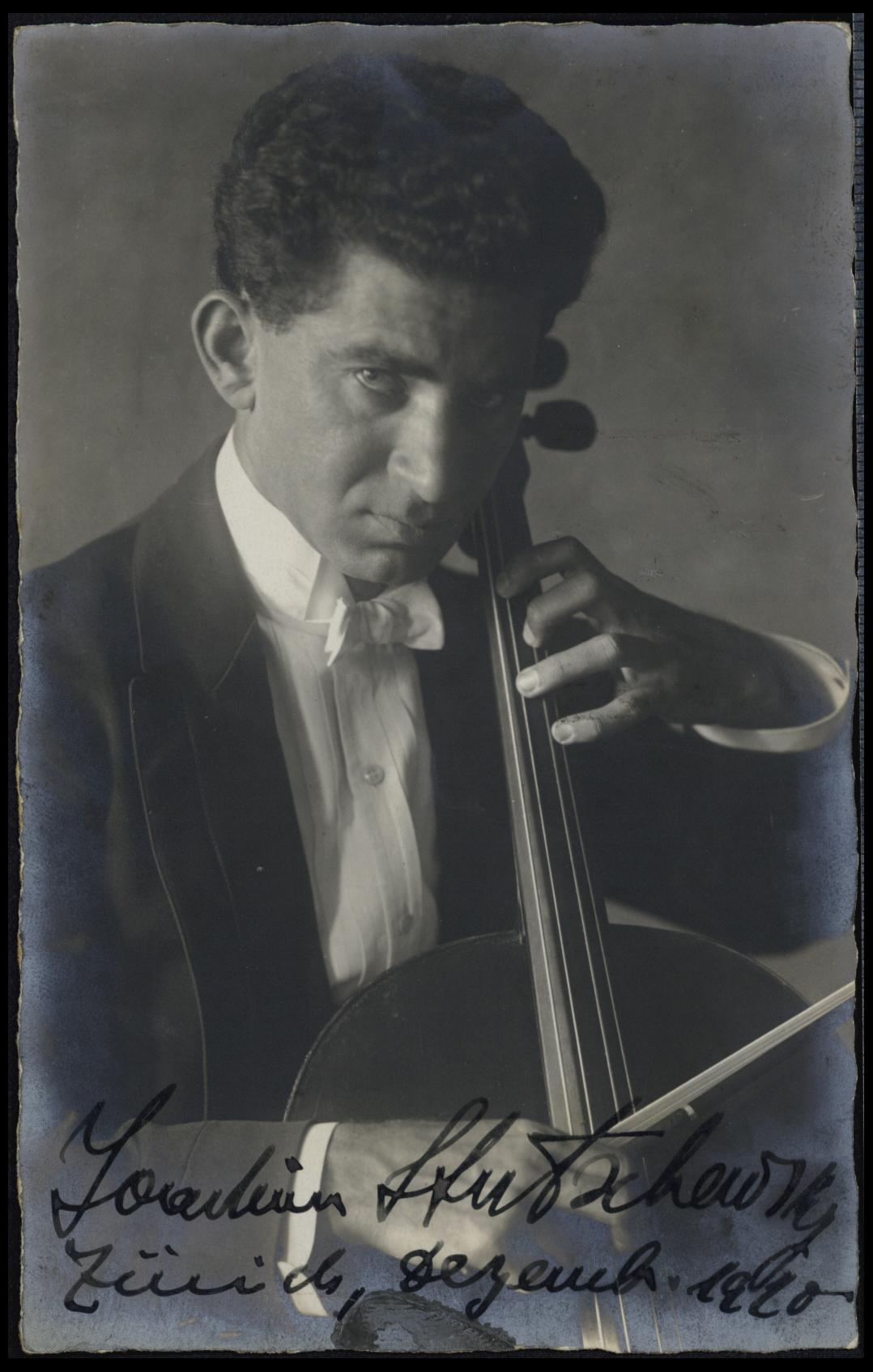
Joachim Stutschewsky, Zürich, c. 1920. The National Library of Israel, Department of Music.


Early Years:  Ukraine, Germany and Switzerland, 1891–1924

Stutchewsky was born on 7 February 1891 in Romny, Ukraine, to a three-generation family of klezmers from both parents’ sides. As a young boy he played the drum in his father’s bands throughout the Ukraine, which was the epicenter of shtetl culture. Typical of the klezmers’ lot, his family was in constant search for engagements. His father Kalman-Leib Stutschewsky, a clarinettist, had to move numerous times with his wife,[2] sons and brother (Daniel, a bass-player) from Romny to Nikopol, Kachovka, Beryslav and finally to the major city of Cherson. Cherson was large enough to boast a theatre orchestra, where a cello vacancy inspired the eleven-year-old to pursue the life of a professional musician as an escape from the daily grind as a delivery boy. The town also boasted one cello-teacher and the inevitable town drunk; unfortunately, in Cherson those two people were one and the same. Stutschewsky nevertheless managed to join the local orchestra within seven months of teaching himself how to play.         

The following year he won an audition to become principal cellist of the Nikolaiev summer orchestra, whereupon he gained an increasing reputation as a gifted young professional cellist and received lessons from better instructors. At seventeen he met the Jewish-Ukrainian violinist Alexander Schaichet (1887–1964) who became a friend and colleague for life. On Schaichet’s suggestion, Stutschewsky applied and gained entry to the studio of the renowned cellist Julius Klengel at the Leipzig Conservatory, who also counted among his students Emanuel Feuermann and Gregor Piatigorsky. He graduated with honors in the spring of 1912, equipped with a letter of recommendation from Klengel who recognized Stutschewsky as ‘a cellist of excellent skills, who will honor any orchestra both as principal cellist, and as brilliant soloist’.[3]

m

Joachim Stutschewsky and Alexander Schaichet, Zürich, 1915. The National Library of Israel, Department of Music.

But a soloist’s lifestyle centered mainly on practicing the cello seemed meaningless to the young graduate, who was distressed by ‘the gap between politics and the arts, and between the sorrow of the world and cello-playing’.[4] But he put aside these lofty concerns for the moment: his immediate goal was to avoid the Russian army draft by finding work in the film-theatres and cafés of Kherson, Yekaterinburg and Paris before settling in Jena, south-west of Leipzig.[5] Schaichet, who graduated from the Leipzig Conservatory a year earlier than Stutschewsky, invited him to join the Jena String Quartet. Jena was a small university city, and its population created a stimulating atmosphere for music-making.          

During this period (1912–14) Stutschewsky was acquainted with the charismatic and celebrated pianist-composer Max Reger (1873–1916). Stutschewsky had a recital scheduled with Reger, but the outbreak of World War I meant that those plans never materialized. Stutschewsky and Schaichet were forced to remain in Switzerland (during an interrupted vacation in Lungern) and did not return to Jena; as Russians, they were citizens of an enemy country and could not return to Germany. Consequently, they decided to settle in Zürich where, despite all previous professional accomplishments, they had to build their lives from scratch.

Zürich – a hotbed of intellectual fervor during the First World War[6] – reawakened Stutschewsky’s identity crisis, which in turn marked the beginning of his path as a composer. Emerging as a socially conscious artist and citizen of the world, he immersed himself in the rigorous debates of fellow Russian refugee intellectuals and Zionist students. Although he thought of himself as a cosmopolitan, modern Jew, Stutschewsky became increasingly conflicted over what that meant:

The duality between an artist and a politician; the individual and the people; the belief and the knowledge; the learning and the action – all these dualities struggled within me without any success in trying to compromise and bring to agreement between themselves [….] I have finally found my way, my goal of life as a Jew and a musician; I have embarked on the thorny path of a Jewish musician.[7]

---- a new fire propelled within me, a fruit of the soul’s flow from generations: I mean Jewish music. Slowly this idea emerged, grew and matured until it became a passion of the soul. Here was also hidden the seed of my creative impulse, which started showing up only at this moment.[8]

He had already tested his abilities as a composer with arrangements of classical violin and cello duets, in collaboration with Schaichet.[9] He recognized, though, that to write original compositions would require a more sophisticated methodology than simply recalling melodies from his youth:

In a spontaneous way I realised the need, an impulse for our own art music. […] But first thing first, I had to research the new field, to know what’s in it, and to be well acquainted with the treasures of our folksongs. I invested myself in the research of our songs and nigunim (tunes). I wanted to organize evenings of Jewish folksongs.[10]

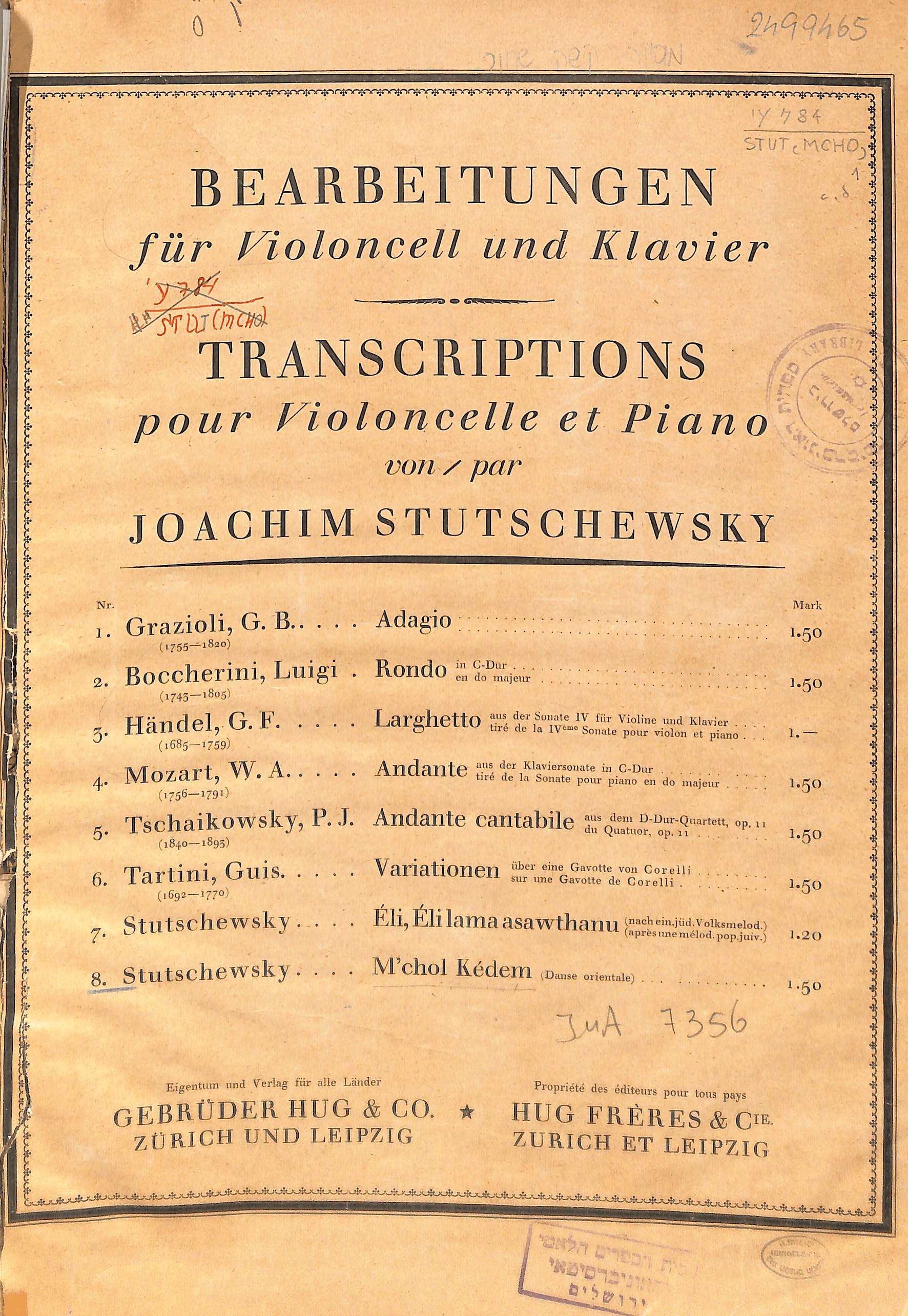
Perhaps the best marker of this period in Stutschewsky’s life is the compilation for cello and piano Bearbeitungen für Violoncell und Klavier (Arrangements for Violoncello and Piano), published in 1923 by Hug Brothers & Co. It included six transcriptions for cello and piano of Baroque and Classical works, side by side with his own arrangement to the melody of the Hebrew/Yiddish song Èli, Èli lama asawathanu? [sic] (God, why have you forsaken us) and an original piece M’chol Kedem – Danse Orientale.  This would testify to the co-habitation of Jewish and Classical repertories in the cellist-composer’s view.
/

Cover page of Joachim Stutschewsky: Bearbeitungen für Violoncell und Klavier (Arrangements for Violoncello and Piano), Hug Brothers & Co., Zürich and Leipzig, 1923. The National Library of Israel, Department of Music.


Joachim Stutschewsky
M’chol Kedem (Danse Orientale)

dedicated to Alexander Schaichet, Zürich, 1923.
Joachim Stutschewsky, cello, Frank Helmut, piano, recorded for the Israel Broadcasting Authority, 1954.

Joachim Stutschewsky
M’chol Kedem

Orchestrated by Karel Salmon, recorded by the Israel Broadcasting Authority Orchestra under the direction of Chanan Schlezinger, 1957.

Stutschewsky’s impulse to spend such evenings with like-minded musicians was indicative of a larger movement that had sprouted in Russia and was spreading throughout Europe. He became increasingly aware that this wave of Jewish nationalism in music was happening independently at the same time in different places. Through the circulating scores of their publishing houses in Saint Petersburg, Moscow and Berlin, the cellist was able to familiarize himself with the music of composers from the Society for Jewish Folk Music.

A pivotal figure of Jewish art music in Russia was Joel Engel (1868–1927), whom Stutschewsky met at a concert in Berlin in 1923. They struck up a lasting friendship, which paved the way for Stutschewsky’s connections with the other members of the Society. He referred to Engel as ‘the lion in the group’ and testified to his impact:

I risked my entire career as cellist, as this activity of mine withdrew to the background. I was aware of it. Many of my friends were sorry for that. But what could I do? Someone had to take upon himself the important task of Jewish music and to continue the legacy of Joel Engel.[11]

On their meeting, Stutschewsky showed Joel Engel his work Dwejkuth (Méditation Hebraïque). Although written after M’chol Kédem, Stutschewsky considered it his first rich, serious piece in Jewish style. The title and subtitle reveal a duality that established the basis of this piece. On the one hand, the Yiddish title Dwejkuth (Devotion), echoes the Hasidic movement’s ideal of heartfelt devotion for God. On the other hand, the subtitle – Méditation Hebraïque – express the harkening back to the Hebrew people’s biblical past. Impressed by the work, Engel accepted it for publication under his publishing house Juwal in Berlin.

Joachim Stutschewsky
Dwejkuth (Méditation Hebraïque) (Zürich, 1924)

Published by Juwal, 1925, reissued by Or-Tav, 1975.
Joachim Stutschewsky, cello, Frank Helmut, piano, recorded by the Israel Broadcasting Authority, 1954.

Engel, after becoming more convinced by the Zionist cause, set an example for other Jewish composers by emigrating to Palestine in 1924. Stutschewsky would follow in Engel’s footsteps, almost literally, and take on the leadership in the research and diffusion of Jewish musical traditions in Israel after the premature death of the master in 1927. In many ways, Stutschewsky’s emigration and subsequent four decades of professional activities in British Palestine and the new State of Israel were an extension of Engel’s legacy.


Formative Years: Vienna, 1924–38

How did Stutschewsky find himself at the epicenter of the Central European musical avant-garde scene? A providential meeting with the violinist Rudolf Kolisch occurred in March 1924 during a concert of the Austrian Society for New Music, where Stutschewsky was invited to perform a solo cello sonata by Egon Wellesz. Kolisch, a protégé and eventual brother-in-law of Arnold Schoenberg, invited Stutschewsky to join him in Vienna where, in 1924, they established the Neue Wiener Streichquartett along with the violinist Fritz Rothschild and violist Marcel Dick. With the intention of becoming the leading interpreters of the Second Viennese School with an international touring schedule, they rehearsed twice a day and were coached at times by Schoenberg himself. On 8 January 1927, the Quartet gave the premiere of Alban Berg’s Lyric Suite.

Stutschewsky’s membership in the Viennese String Quartet was short-lived.[12] Although he admired the ‘authoritative and charismatic’ Arnold Schoenberg, he felt intimidated about writing his own music while learning the masterpieces of the modern quartet repertoire: “The connection with Viennese composers, the detailed learning of their […] compositional techniques, brought doubts and non-confidence to my own work.”

Free to pursue personal projects after leaving the Quartet in 1927, Stutschewsky began a six-volume cello method, ambitiously titled The Art of Playing the Violoncello: A System of Study from the Very Beginning to a Stage of Perfection, which would eventually cement his reputation as a pedagogue. For cellists wishing to follow his teachings, he organized summer camps held in the pastoral area of Obernberg, Austria, for three consecutive summers, from 1935 to 1937.           

His creative output in Vienna included works for piano solo and for cello and piano based on Jewish themes. In spite of the complexity of the music by Schoenberg, Berg, Bartók Hindemith and Webern, Stutschewsky was inspired by the innovative structures of these masters’ works and found freedom for his individual expression. Thus, while he remained within the confines of the tonal language, he incorporated harmonic surprises and more virtuosity in his own writing for both the cello and the piano.

Joachim Stutschewsky
Vier Jüdische Tanzstücke (Four Jewish Dances) for Piano (Vienna, 1929)

Published by Universal Edition in 1930, reissued by Israel Music Publications (IMP), 1968.
Frank Peleg, piano. Recorded for the Israel Broadcasting Authority, 1951.

Joachim Stutschewsky
Vier Jüdische Tanzstücke (Four Jewish Dances)

Orchestrated by the composer in 1940, recorded by the Israel Broadcasting Authority Orchestra under Michael Taube, 1956.

The pieces for cello and piano included the compilation Trois Pièces Hébraïques: Kinah (Elegy), Meditation Chassidique, and Frejlachs, composed between 1933 and 1934, and ‘Jewish Song’ composed in 1937, at the eve of the Anschluss.

More significantly, Vienna in the 1920s and ’30s proved to be the first of two benchmark eras whereby Stutschewsky emerged as a central figure in the field of contemporary Jewish art music. As a writer, he presented his opinions in the Viennese Zionist journal Die Stimme and the Prague-based journal Selbstwehr. Taking a lead from his colleagues of the St Petersburg Society, he mounted concerts and lectures by organizing his own Verein zur Förderung jüdischer Musik (Society for the Promotion of Jewish Music) in 1927.

In the shadow of the growing anti-Jewish atmosphere in Central Europe, Stutschewsky maintained extensive correspondences about the state of Jewish music with friends and colleagues beyond the borders of Europe as an option for future steps. Indeed, thanks to the efforts of Dr Sally Levi and the journalist Hermann Swet, founders and directors of the World Centre for Jewish Music in Palestine, he received an invitation to work as the director of Jewish music at the newly-established Palestine Broadcasting Service (PBS, established 1936).[13] Stutschewsky and Regina Schein, his Swiss cello-student and fiancée, fled from Vienna to neutral Zürich in 1938, where they received the proper paperwork for immigration into Palestine. The Nazis marched into Vienna only weeks later.


Life in a New Land: Jerusalem and Tel Aviv, 1938–82

It was a marvellous sunrise in Jerusalem that morning [....] For the first time in my life I felt the Orient: Romantic, fantastic![14]

Thus, Stutschewsky described his first impression of Jerusalem upon his arrival. The Mediterranean landscapes, the sounds of Hebrew, Arabic, Yiddish and other European languages, and the mixture of oriental and occidental sights were later reflected in his music. Palestine appeared to be the ideal birthing ground for Stutschewsky’s mission: a music for the renewing Jewish nation in its land.

But this sincere and noble vision immediately found itself at odds with reality. Stutschewsky had already programmed his first broadcast on behalf of the PBS, including specifically commissioned works, when he learned of his abrupt dismissal from the radio job that had been created for him and had probably saved his life. He had a strong vision in the field of music education in the Yishuv, a field where he acted enthusiastically with the title of Inspector for Jewish Music of the Va’ad Leumi.[15] However, also in music education he suffered a considerable disappointment: his comprehensive plan – encompassing such necessary tools as musical instruments, Hebrew sheet-music for choirs and ensembles, recordings, trained teachers and educational concerts – was widely ignored. Although Jewish officials of the Yishuv encouraged his programs and intentions, no financial support was granted.

Another dream was shattered when The World Centre for Jewish Music in Palestine, the organisation that made possible Stutschewsky’s immigration, ‘was announced with such pathos and enthusiasm in the Jewish world at the beginning, but was found to be an ambitious fantasy-dream, with no basis in reality and with no real form, a terrible illusion’.[16] In 1939, Stutschewsky moved to the more cosmopolitan city of Tel Aviv, where the atmosphere was more conducive to professional artistic opportunities. Nonetheless, large projects such as the undertaking of a publishing house exclusively dedicated to Jewish music failed to materialize, and plans for a Library for Jewish Music (Sifriya Le-musika Yehudit) were aborted as well.

These setbacks should be considered within the context of attitudes towards music in the Jewish society during the British Mandate period, and later in the early years of the State of Israel. We can distinguish three trends. The first one is the creation of a new song repertoire in Hebrew (disguised as “folk song”, Hebrew: shir ‘am) reflected the idea of the “negation of the [Jewish] Diaspora” (Shlilat Ha-golah) that dominated intellectual circles in the newly created State aspiring to implement a musical ‘melting pot’. The Zionist Labor establishment nurtured an image of the new, strong and proud ‘Hebrew man’ and rejected any reminiscence of the imagined fragile diasporic Jew and his musical traditions. On the other hand, composers of art music embraced progressive international trends like dodecaphony, atonality and electro-acoustic styles, and presented music as the individual’s mean of expression.[17]

Another emerging trend was a ‘Mediterranean Style’ that reflected the freedom, landscapes, biblical allure and the exotic orientalism that the composers discovered in their new homeland.[18] Any positive identification with cultural assets of the Diaspora, such as Yiddish language and literature or klezmer music, were regarded as an obsolete remnant of the past. Stutschewsky’s ideas about historical continuity and perpetuation of Jewish musical genius were thus at odds with the consensus in a Zionist society preoccupied with immediate concerns like establishment of the State of Israel and its security.

Joachim Stutschewsky
Suite for violin and piano, Tel Aviv, 1940.

First piece written in Palestine
Published by Or-Tav 1973.
Alexander Tal, violin, Moshe Lustig, piano, recorded for the Palestine Broadcasting Service, 1940.

Stutschewsky, self-identified as a Jewish musician, was frustrated to find himself the minority in a country of Jews. Not only did he find a lack of support for his own musical projects, but he was also flummoxed by the lack of Jewish programming from the Classical-music establishment. As early as 1938 in Vienna he railed against the slavish devotion to ‘a few dead, baptised composers’ by Jewish musicians and musical organizations, such as the Palestine Symphony Orchestra.[19] He complained that

the directorship of the orchestra is unfortunately so inclined that this marvelous instrument has not and cannot have the slightest interest in our cultural aspirations [….] It has neither a connection to Jewishness nor to Eretz Yisrael nor to Jewish culture. But it is in itself not so bad that it does not have this connection; what is terrible is that it is not the least bit inclined to acquire this or to make any changes.[20]

Although he experienced deep disappointment and faced continuous struggle in his forty-four years in Israel, Stutschewsky remained creative and forceful throughout his professional life, and his efforts were gradually recognized. He became known as a traveling cellist who, with his second wife, the soprano Julia Stutschewsky, visited kibbutzim and villages across the country to spread knowledge of and feeling for Jewish music. At the Workers’ Circle in Beit Brenner, Tel Aviv, for example, between 1938 and 1942 he succeeded in producing twenty-six Jewish art-music programs, including newly commissioned works by Israeli composers (although he often had to cover expenses out of his own pocket).

A constant concern of Stutschewsky was the creation of educational repertoire for Jewish children and youth. The mission of his educational works was both instrumental teaching, as well as the identification with Jewish musical heritage while fostering a new Israeli sound.  In consequence, Stutschewsky’s educational repertoire for piano, cello, voice, and chamber ensembles is set to Hebrew poetry as well as Jewish themes. This undertaking threaded since his Zürich and Vienna periods and throughout his life in Israel.

Joachim Stutschewsky
Ha-be‘ivar He-aliz (The Happy Zoo), four songs

Lyrics: Lea Goldberg. Tel Aviv, 1949.
Published by the Cultural Department of the Histadrut, 1951.
Julia Stutschewsky, soprano, Moshe Lustig, piano, recorded for the Israel Broadcasting Authority, 1950.

Stutschewsky’s research in both Jewish music and cello pedagogy yielded 385 published articles. His ground-breaking monograph Ha’Klezmerim: Toldotehem, Orah Hayehem ve-Yetzirotehem (‘Klezmorim: Their History, Folklore and Compositions’)[21] was the first serious musicological study in Hebrew on klezmer music and earned him the prize named after his mentor, the Joel Engel Award. He received the Piatigorsky Prize in 1963 ‘in recognition of many years of devotion to music and to the art of cello-playing’, and was named an Honorary Citizen of Tel Aviv in 1977.

As a composer, Stutschewsky admitted that his ‘individual style’ finally took shape in Israel, where folk sources were infused into a more contemporary musical language. In addition to sixteen Jewish-themed works for cello and piano, there are forty-three chamber and unaccompanied instrumental pieces, a dozen piano works, two cantatas, and numerous vocal and choral song-cycles and collections in Hebrew. In 1961 and 1973 the Israel Philharmonic itself honored Stutschewsky with premieres of his major orchestral works: the symphonic poem Zfat (the Hebrew name of the city of Safed) and the symphonic suite Israel.

Joachim Stutschewsky
Israeli Dances for flute, cello and piano (Tel Aviv, 1954)

Hanoch Tel-Oren, flute, Joachim Stutschewsky, cello, Arieh Sachs, piano.

Joachim Stutschewsky
Concertante Music for flute and strings (Tel Aviv, 1963)

Hanoch Tel-Oren, flute, the Israel Broadcasting Authority Orchestra under the direction of Mendi Rodan.

Stutschewsky’s diverse body of work—spanning composition, scholarship, and concert performance—was inextricably linked to his socio-political ideals. His career chronicles the life of a conscientious artist working within a transformative historical landscape marked by global conflict and national rebirth. He served as an influential mentor to a younger generation, encouraging composers and performers alike to bridge the Eastern European and Mediterranean dimensions of their heritage. His prolific and artful output reflected a profound commitment to the exploration of Jewish music, and his scholarly and artistic contributions remain a significant point of reference for those engaged today in research, performance, and pedagogy in the field.

References

[1] Parts of this essay appear in Racheli Galay and Aron Zelkowicz “Joachim Stutschewsky: The Thorny Path of a Jewish Musician” in the CD Joachim Stutschewsky: Chamber Music. London: Toccata Classics, TOCC 0314, 2016. Both articles drawn from Racheli Galay-Altman, Joachim Stutschewsky: Works for Cello and Piano in the Jewish Style, Northwestern University, Evanston, Illinois, 2007.

[2] Kalman’s second wife; Joachim’s mother died when he was about a year old.

[3] Joachim Stutschewsky, Haim bli Psharot: Korot Hayav shel Musicay Yehudi (‘Life without Compromises: Memoirs of a Jewish Musician’), Tel Aviv: Sifriat Po’alim, 1977, p. 59.

[4] Ibid., p. 56.

[5] In a smaller city like Yekaterinenburg it was much easier to get away from the threat of being drafted. Men of age 21 in Czarist Russia were supposed to be drafted into the Russian army for three years and could avoid the draft only had they had enough money for a bribe.

[6] The personalities who took refuge there during the War include Ferruccio Busoni, James Joyce, Vladimir Lenin and his wife, Stefan Zweig, Hans Arp, Tristan Tzara and a number of their fellow Dadaists, and a hoste of other movers and shakers.

[7] Op. cit., p. 114.

[8] Ibid., p. 126.

[9] As the Schaichet-Stutschewsky Duo, they performed violin-and-cello programs throughout Switzerland. The lack of repertory for this combination induced them to create their own arrangements.

[10] Op. cit., pp. 126–27.

[11] Op. cit., p. 127.

[12] Stutschewsky was replaced by Benar Heifetz (no relation to the violinist). Renamed the Kolisch Quartet, this more familiar line-up continued until the Second World War (1927–39). The Quartet would premiere Schoenberg’s Third and Fourth Quartets and Bartók’s Fifth and Sixth, and become known for performing from memory. For a more complete history, cf. Tully Potter’s booklet notes, ‘A History of the Kolisch Quartet’, The Great Violinists, Vol. 16, Symposium Records cd 1304.

[13] See, Andrea L Stanton, Jerusalem Calling: State Radio in Mandate Palestine (University of Texas Press, 2012). 

[14] Ibid., p. 199.

[15] Va’ad Leumi was a Zionist official pre-Israeli state organization in Palestine.

[16] Stutschewsky, op. cit., p. 205.

[17] As in the works of composers Joseph Tal, Abel Ehrlich, Haim Alexander and, especially, Stefan Wolpe.

[18] The works of the composers Paul Ben-Haim, A. A. Boskovitch, and Marc Lavri can be adduced here, in addition to Stutschewsky’s.

[19] Letter to Hermann Swet, dated 23 January 1938, published in Philip V. Bohlman, The World Centre for Jewish Music in Palestine 1936–1940: Jewish Musical Life on the Eve of World War II, Oxford University Press, New York, 1992, pp. 216–17.

[20] The ‘directorship’ which bore the brunt of Stutschewsky’s criticism in this letter was aimed at the founder of the orchestra, Bronisław Huberman, and its director, William Steinberg. Steinberg’s previous post was, ironically, with the Jüdischer Kulturbund (Jewish Culture League), which was set up in Germany by the Nazis in 1933 to make sure that Jews did not play music by German or other non-Jewish composers. The Palestine Symphony Orchestra would become the Israel Philharmonic Orchestra, and Steinberg would go on to become the long-serving music director of the Pittsburgh Symphony Orchestra.

[21] Bialik Institute, Jerusalem, 1959.


Join Our Newsletter

Subscribe to our newsletter to get updates