



Reprinted from the Journal of Jewish studies, vol.18 (1967), nos. 1-4
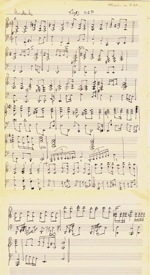
Two recordings of 'Baruch ha'gever' from Obadiah the Proselyte's Hebrew musical manuscripts, arranged by Andre Hajdu and performed by the Jerusalem Children's Choir under conductor Yonatan Lesser.
Recording of 'Wa-eda mah' from Obadiah the Proselyte's Hebrew musical manuscripts, arranged by Andre Hajdu and performed by the Jerusalem Children's Choir under conductor Yonatan Lesser.
Recording of 'Mi 'al har hôrev' from Obadiah the Proselyte's Hebrew musical manuscripts, arranged by Andre Hajdu and performed by the Jerusalem Children's Choir under conductor Yonatan Lesser.
Recording of Mi 'al Har Hôrev from Obadiah the Proselyte's Hebrew musical manuscripts found in the Cairo Genizah in 1965.
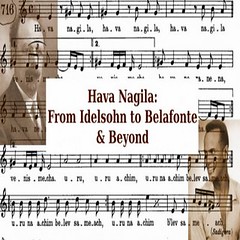
Click Here for Slide Show
This entry is part of an online exhibit entitled: 'Hava Nagila: From Idelsohn to Belafonte & Beyond,' prepared by Eva Heinstein with help from the JMRC staff. To view the exhibit in its entirety click on the link above.
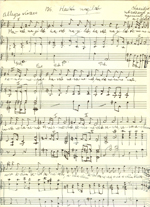
Click Here for Slide Show
This entry is part of an online exhibit entitled: 'Hava Nagila: From Idelsohn to Belafonte & Beyond,' prepared by Eva Heinstein with help from the JMRC staff. To view the exhibit in its entirety click on the link above.
Click Here for Slide Show
This entry is part of an online exhibit entitled: 'Hava Nagila: From Idelsohn to Belafonte & Beyond,' prepared by Eva Heinstein with help from the JMRC staff. To view the exhibit in its entirety click on the link above.

The Testament of Job is an external book originally written in Greek by one of the Jewish cults in Alexandria in the first century BCE or AD. It is part of the “testament of the forefathers” genre prevalent in the external books. In the testament of Job many verses about music are of musical and musicological interest. Names of musical instruments are mentioned as are antiphony and musical notation. Scholars who translated the text from Greek to modern languages often translated the instrument names inaccurately and did not delve into the musical aspects of the text. Job’s testament is written in a realistic manner as a screenplay of a liturgical drama including many visual descriptions. The drama takes place in an upper class setting where musical activity is the norm- a scene which would not be foreign to the Hellenistic surroundings but has little similarity to the Jewish sources of that time.