By Edwin Seroussi
In the spring of 2019, while serving as a fellow at the Katz Center for Advanced Judaic Studies at the University of Pennsylvania, I was fortunate to meet Dr. Rabbi Jonathan Rosenbaum. Dr. Arthur Kiron, Schottenstein-Jesselson Curator of Judaica Collections at Penn, introduced him to me as President Emeritus of Gratz College. The moment I heard the words “Gratz College,” I immediately asked, “What about the Mandell Collection of Jewish Music?” Surprised by my reaction, Dr. Rosenbaum asked for an explanation, and I replied that, for those of us who have worked in Jewish music for decades, the name “Mandell” is legendary. “Frankly,” he responded, “I was not aware that the collection was so significant.”
Indeed, Eric Mandell (1902–1988) was well known among students of Jewish music as one of the field’s leading collectors and scholars. Yet, some twenty years ago or more, he gradually vanished from the horizon of Jewish music scholarship. This disappearance was neither deliberate nor the result of any conscious decision. Rather, public interest in his life's work simply faded at the institutions where this German-American cantor, composer (most American congregations still sing his Ahavat ‘Olam without knowing its author), choirmaster, and devoted memorializer of synagogue music had left a lasting imprint, above all at Gratz College in Melrose Park, Philadelphia.
This gradual oblivion is understandable in light of the changing priorities of American Jewry, including its musical priorities. Mandell’s collection became a repository of silent sounds from a forgotten era, even if that era lay only one or two generations in the past. The aesthetics of Jewish liturgical music in America changed with remarkable speed, and before long a thick layer of dust had settled over the memory of Mandell and his extraordinary legacy.
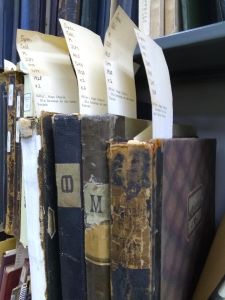
A few weeks after meeting Rabbi Rosenbaum, I visited Gratz College. What I found there was disheartening. A relatively modest locked room housed one of the great treasures of Jewish musical culture. Much of the collection was only partially visible, obscured by boxes scattered across the floor and by obsolete audio equipment and furniture left over from the College’s discontinued music program. By sheer chance, however, my eye was immediately drawn to several uncatalogued manuscript volumes lying haphazardly atop a pile of unrelated materials. These proved to be the legacy of Cantor Maier Levi of Esslingen, one of the earliest and most important repositories (1850s–1860s) of the traditional liturgy of southern German Jewry. I knew all too well why these manuscripts happened to be resting on top of the pile. Earlier that very year (April 2019), the Jewish Music Research Centre at the Hebrew University had published Between Tradition and Modernity: The High Holy Days Melodies of Minhag Ashkenaz According to Ḥazzan Maier Levi of Esslingen by Dr. Geoffrey Goldberg, who had identified and studied these manuscripts at Gratz in the late 1990s. Where he had left them then, there they had remained untouched for more than two decades.
These remarks should not be understood as suggesting that Gratz College neglected the Mandell Collection after its acquisition in 1970. Quite the contrary. The College fully appreciated the value of the collection entrusted to its library and cared for it responsibly. In its new premises, inaugurated in 1989, a dedicated room was designed for the Mandell Collection, equipped with appropriate temperature and humidity controls as well as secure access. The printed books in the collection were catalogued and remain searchable through the online catalogue of the Gratz Library.
As my stay in the United States came to an end without further progress, I returned to Israel hoping that the dialogue initiated with Gratz would bear fruit in the not-too-distant future. Then came COVID, and life, for all practical purposes, was placed on hold. In November 2021, still under the restrictions imposed by the pandemic, my wife Cantor Marlena Fuerstman and I were fortunate to return to Philadelphia. In the meantime, Gratz had appointed a new president, Professor Zev Eleff. During our very first meeting, Professor Eleff immediately recognized that he had become the steward of an exceptional cultural treasure, one requiring urgent attention. More importantly, he understood that the significance of the Mandell Collection for scholars, students, educators, and performers demanded its prompt digitization, thereby democratizing access to its holdings for users around the world, including in Germany, where Mandell’s name remains familiar among those devoted to Jewish music and culture. Gratz has since received a major grant from the Kort Foundation to support this undertaking.
What struck me from the outset was that the manuscript section of the Mandell Collection—arguably its most valuable and unique component—had remained uncatalogued for nearly half a century. The precarious and disordered state of these materials led me to focus my attention on them, and, sure enough, one astonishing discovery followed another, leaving me repeatedly amazed. I shall mention only one example, which speaks volumes about both the collection itself and its remarkable history.
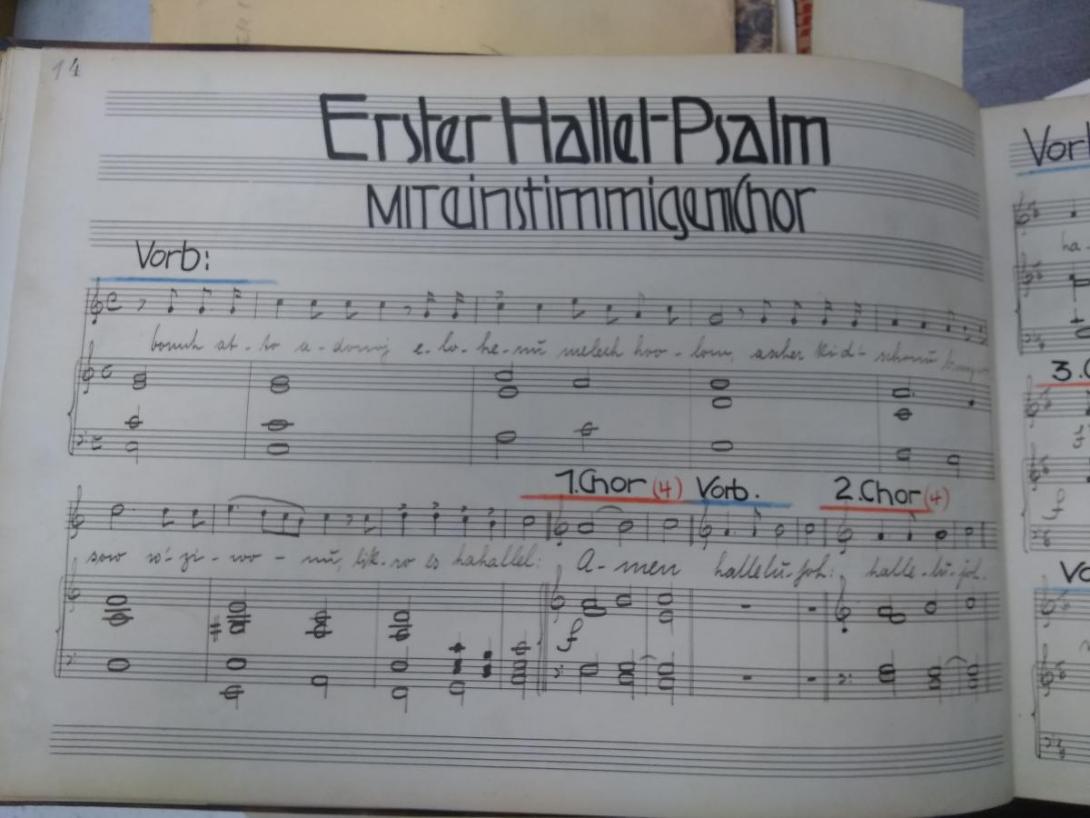
On my very first day at Gratz, the corner of my eye caught sight of four lavishly bound manuscript volumes. Dated 1928, they contained music compiled by the cantor and composer Hugo Chaim Adler (1894–1955) for the Hauptsynagoge of Mannheim, where he served as Oberkantor (Chief Cantor) for the two decades preceding the Second World War. The moment I saw these volumes, I wasted no time in contacting his son, the distinguished American composer Professor Samuel Adler. Sam was stunned by the news. He knew that his father had entrusted these volumes to Eric Mandell upon his arrival in America in 1941, after rescuing them only days after Kristallnacht from the devastated synagogue in Mannheim. Hugo Adler had entered the ruined building through hidden subterranean passages, slipping beneath the noses of Nazi guards and risking not only his own life but also that of his ten-year-old son Sam, who accompanied and assisted him in the rescue. Rumors of a mysterious fire at the old Gratz College building, believed to have destroyed the volumes, had led Sam to conclude that the precious manuscripts—for which both he and his father had nearly paid with their lives—were lost forever.
This story speaks volumes about the complicated fate of German-Jewish musical heritage in America. Gratz College carefully preserved Hugo Adler's invaluable manuscripts for more than eight decades. Elliott Kahn, former music librarian at the Jewish Theological Seminary, even mentioned them in a footnote in Musica Judaica (15 [2000–2001], p. 53, n. 16). Yet, paradoxically, they remained effectively lost to the one person who cared about them most throughout his life.
By restoring these volumes to the attention of the 1928-born Samuel Adler, we fulfilled, in a modest way, an ancient commandment (Deuteronomy 22:1–3, slightly adapted):
If you see your fellow Israelite's manuscript gone astray, do not ignore it, but be sure to return it to its owner. If the owner does not live near you or you do not know who the owner is, take it home and keep it until the owner comes looking for it. Then return it. Do the same if you find... anything else they have lost. Do not ignore it.
If this were the only achievement resulting from bringing the Mandell Collection back into the scholarly spotlight, dayyeinu—it would already have been enough.