



Huether, Kathryn. "Pre-Mediation and the Crisis of Experiential Memorialization: Listening to the Nova Exhibition." Yuval: Studies of the Jewish Music Research Centre, vol. XIV (2026). https://jewish-music.huji.ac.il/en/node/25124

The Nova Exhibition
Pre-Mediation and the Crisis of Experiential Memorialization: Listening to the Nova Exhibition
Copy citation

The Chicago Manual of Style
Abstract
This article argues that the Nova music festival exhibition operates as a second-order immersion: a carefully staged sonic arc that follows, rather than precedes, the platformed experience of October 7, 2023. Drawing on scholarship in sound and memory studies, I show how visitors arrive already saturated with “viral witnessing”: clips, overlays, and algorithmically amplified soundtracks that pre-mediate atrocity in real time, shaping listening dispositions before the museum encounter. Situating Nova within the genealogy of late twentieth- and early twenty-first-century experiential memorial museums (USHMM, Yad Vashem, the 9/11 Museum), I trace how its curatorial strategies inherit the affective ambitions of what Amy Sodaro terms “performative spaces,” while contending with platform-conditioned listening that fragments reception. Through close analysis of five auditory environments—contextual orientation, refracted immersion, memorial convergence, testimonial resonance, and reflective aftercare—I demonstrate how cues such as an orchestral “Hatikvah,” curated silence, testimonial scoring, and ambient decompression collide with prior memetic soundtracks and platform tropes (sonic wallpaper, remix, refrain). In the contemporary “memory wars,” these collisions yield heterogeneous auditions: grief and identification for some; skepticism, irony, or political resistance for others. I contend that the sonic design of Nova reveals both the possibilities and limits of immersive memorialization in the platform era: it can slow the feed and scaffold ethical listening, yet it risks reproducing spectacle and meme-ready cadence. The article concludes by proposing design principles for contested audition, approaches to memorial sound that acknowledge plural listening positions without forcing affective consensus.
Introduction
On the morning of October 7, 2023—Simchat Torah, a holiday marked by dancing, singing, and communal celebration—thousands gathered in the Negev Desert for the Supernova music festival.[1] By day’s end, armed Hamas militants had crossed from Gaza, killing more than 360 people and taking more than 40 others hostage, resulting in what would be referred to as the “Nova Festival Massacre.”[2] News of the massacre spread not only through official reports but through a torrent of platformed media: TikTok, Instagram, Telegram, WhatsApp. Drone shots of the desert stage, dancers hours before the attack, shaky phone videos capturing gunfire, abductions, hiding places—these fragments permeated the global consciousness. From the outset, the sights and sounds of what had taken place was filtered through the feed of platform culture. In the days and weeks that followed, these same clips were re-mediated: paired with songs, captions, and trends, amplified by algorithms. Through this layering, a mode of “viral witnessing”—the encounter with atrocity through platform feeds in real time, where clips are framed by captions, trends, and algorithmic amplification—took shape: atrocity first encountered within the feed, then transformed, reframed, and recirculated through the banal, the ironic, and the algorithmically popular[3].
For instance, one widely circulated clip showed terrified Nova attendees sprinting across the desert, overlaid with the text “Run like a girl—or like a girl from the Nova festival who just wanted to party but instead watched their friends get shot (sic) and kidnapped” and underscored with Paris Paloma’s 2024 song “Labour,” which had been tied to feminist resistance on social media.[4] Another clip recirculated footage of a survivor hiding in the bushes as the caption described, “for hours,” as gunfire rang out, paired with the track “Never Surrender” by Lux-Inspiria, an example of what I have called “sonic wallpaper”—the ubiquitous, affectively prescriptive background audio on TikTok (and Instagram) that has accompanied more than 147,000 TikTok posts to date. A third took the last Instagram story that Nova victim Shani Louk ever posted and rescored it with Mom Jeans’s “Scott Pilgrim vs. My GPA,” alongside the overlay: “This girl’s last footage alive. She had no idea that she would be k1lled, have her limbs broken and be paraded like an animal for 4 hours after this. Rest in Peace Shani.”[5]
Such juxtapositions of horror with pop culture soundtracks did not merely document October 7; they transformed it, shaping the global memory of violence through the virality and affective economy of platforms. However, not all these transformations were empathetic. Other rescorings circulated that mocked or even endorsed the violence, pairing atrocity with irony or derision (these have now been taken down). One TikTok coupled Hamas’s parading of Louk’s body with Wagner’s “Ride of the Valkyries,” invoking cinematic tropes of triumphant conquest.[6] Another overlaid footage of a victim hiding with the viral sonic wallpaper “Laughing” by Gianluca Marino, transforming terror into spectacle for the sake of ridicule.
For some, October 7 was an immediate rupture; for others, responses were refracted through media ecologies and political positions that framed Israeli suffering as secondary or suspect. These divergent receptions did not remain confined to the digital sphere. They carried into the physical space of the Nova Exhibition, designed by the Tribe of Nova collective together with bereaved families and survivors.
I visited the Nova Exhibition in August 2024, at a moment when nearly one hundred hostages remained in Gaza, with at least forty-eight believed to be alive. This visit occurred just one week before the murders of Hersh Goldberg-Polin, Carmel Gat, Almog Saris, Alexander Lobanov, Ori Danino, and Eden Yerushalmi. The analysis that follows is grounded in my temporal encounter with the exhibition, shaped by the mediated images and sounds of October 7 encountered in the weeks leading up to my visit. Although situated within a volatile political moment, it examines the ongoing structures of mediation and reception that continue to shape interpretation.
The Nova Exhibition reconstructs the festival grounds through artifacts, sound, and immersive staging to commemorate October 7 (see images 1 and 2).[7]

Image 1: Nova Porta-Potties[8]

Image 2: Destroyed Cars from the Nova Festival
In the exhibition, mediated fragments of the attack are restaged as curatorial objects, and even the same symbolic artifact might register in sharply different ways. For visitor Cate Rubenstein, the display of shoes (image 3) under a “lost and found” sign was devastating:
It was the shoes that got me. A sign: “lost and found.” Viscerality broke me apart from the inside. Shoah exhibits already, shoes by the Danube in Hungary. Knowing last time these were worn was by someone who died horrifically. (Rubenstein 2024)
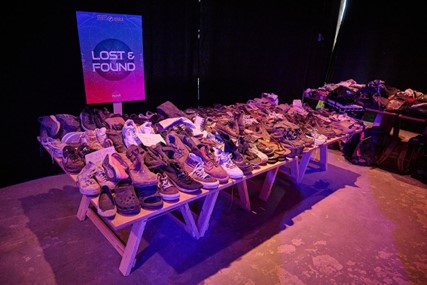
Image 3: Nova Shoes
For Rubenstein, the shoes opened a direct line to embodied grief, layered with the memory politics of Holocaust memorials. By contrast, in the satirical podcast BadHasbara, the same display became material for ironic distance. One host mocked the premise of the exhibition by joking that in the chaos of the attack he, too, would have abandoned his belongings—“my portable charger I left there”—while another skewered the curatorial framing, noting how the shoes were presented almost as if a museum guide were needed to explain why victims fled without their bags. At the same time, the hosts recognized how the display echoed Holocaust memorial tropes: “For so many people, it’s very reminiscent of what they see at the Holocaust museum.… It gives you the scope of what was lost that day.” The mix of irreverence and recognition highlights how the shoes could be received simultaneously as a devastating marker of absence and as an overdetermined symbol. Taken together, these responses show how a single sensory cue—in this case, a pair of shoes—can evoke visceral empathy, ironic critique, or pointed resistance, depending on political stance, personal memory, and cultural reference points within the same commemorative space.[9]
This tension does not mark a departure from the experiential curatorial strategies of late twentieth- and early twenty-first-century memorial museums, but rather a rupture in their reception, driven by platform culture and the sonic pre-mediations visitors carry, which refract intended affect through the fragmented, politicized listening habits of the present. The Nova Exhibition inherits the affective ambition of institutions such as the United States Holocaust Memorial Museum (USHMM) and the National September 11 Memorial & Museum, sites that form part of what the sociologist Amy Sodaro calls “performative spaces,” designed to elicit empathy and model moral reflection (Sodaro 2018a). These strategies, which the historian Alison Landsberg describes in terms of “prosthetic memory” and the performance studies scholar Baz Kershaw situates within the “performative society,” reflect an era when theatricalized commemorations and public rituals were understood as capable of cultivating consensus around shared histories and ethical commitments (see Landsberg 2004; Kershaw 2001).[10]
The Nova Exhibition stages a similarly choreographed affective journey, but in a radically different media and political environment. Visitors arrive not as blank slates but bearing sonic and visual memories first encountered in platform-curated feeds, where the same soundtrack might frame footage of atrocities, parody, or irreverent meme culture. These are prosthetic memories of a different order, shaped not by the controlled environment of the museum but by the chaotic circulation of digital media. The exhibit’s soundscape collides with these preexisting associations, producing a space where the same cues can trigger grief, skepticism, irony, or political resistance—often several of these simultaneously. This fracture is not solely the product of digital media but part of a broader shift away from the consensus-building aims of the performative society. Whereas memorial museums once operated in a public sphere that cultivated shared affective responses through immersive environments and symbolic ritual, today’s commemorative spaces contend with what Michael Rothberg terms “memory wars”: deep polarization, rapid-cycle outrage, and mistrust of institutional narratives (see Rothberg 2009).[11] The Nova Exhibition enters precisely such a moment, one not confined to the Israel-Hamas war but reflective of a wider zeitgeist in which political discourse—from presidential elections to campus protests—unfolds in fragmented, adversarial arenas. In such conditions, even the most carefully staged soundscapes become contested terrain.
The Nova Exhibition functions as a second-order immersion, arriving after visitors have already formed—and often publicly performed—interpretations within the algorithmic space of social media. Its auditory environments adapt strategies from Holocaust- and trauma-derived memorial models but must contend with listening habits shaped by the fragmented, politicized, and affectively volatile platform era. Drawing on contemporary sound culture, I examine how the exhibit’s soundscapes attempt to restore coherence yet remain porous to pre-mediated sonic memories, revealing both the possibilities and the limits of shared memorial experience.
In what follows, I first situate the Nova Exhibition within the genealogy of experiential memorial museums, tracing how its curatorial strategies both inherit from and depart from the “performative spaces” of the late twentieth and early twenty-first centuries. I then examine how platform cultures reshape the conditions of reception for traumatic events—such as October 7—showing how sonic and visual memories circulate in algorithmic feeds long before visitors encounter the exhibition. Next, I analyze the exhibit’s five distinct auditory environments, exploring how they attempt to shape, reframe, and contend with these preexisting interpretive frames. I conclude by considering what the Nova Exhibition reveals about both the possibilities and the limits of the performing museum in the platform era, and how sound culture offers a critical entry point for understanding—and potentially reimagining—the fractured politics of contemporary memorialization.
The Genealogy of Experiential Memorial Museums
Experiential memorial museums emerged in the late twentieth century to choreograph not only history but affect. A key precedent is the Vietnam Veterans Memorial (1982), whose minimalist design centered on embodied encounter. As Amy Sodaro argues, such institutions are “performative spaces”: they stage experiences intended to elicit empathy, cultivate moral reflection, and anchor collective memory (Sodaro 2018b, 11). James E. Young describes this as the “theatricalization of memory,” while Alison Landsberg’s “prosthetic memory” explains how architecture, sound, and symbolic objects foster identification with events through which the viewer did not live.[12] This turn coincided with Annette Wieviorka’s “era of the witness,” which made survivor voices central to public culture. Barbara Kirschenblatt-Gimblett likewise reminds us that museums are “performances of knowledge,” transforming fragments into heritage through staged sensory engagement (Wieviorka 2006; Kirschenblatt-Gimblett 1998, 3–5).[13]
The USHMM exhibit, which opened in 1993, became paradigmatic: a choreographed passage through dark corridors, historical artifacts (a railcar), and testimonial video, positioning empathy as a moral and political imperative (Linenthal 2001). Yad Vashem’s 2005 building similarly weds form and feeling—light, concrete, landscape—to produce bodily experiences of rupture and renewal (see Safdie and Ockman 2006). The National September 11 Memorial Museum extended these strategies, layering archival media and voices within spatial immersion and bringing the “performative society” into civic mourning (Kershaw 1999, 19–22).
These logics were soon globalized: experiential design became a template for atrocity and trauma museums—from Johannesburg’s Apartheid Museum to the Equal Justice Initiative’s Legacy Museum and National Memorial for Peace and Justice—within what Paul Williams calls a “global rush to commemorate atrocities” and Andreas Huyssen identifies as a broader “memory boom” (Williams 2007; Huyssen 2003, esp. 99–104).[14] Underpinning them is an affective contract: the presumption that carefully staged immersion can guide visitors toward shared emotion and, ideally, consensus about meaning.
Crucially, the experiential turn was also sonic. Survivors’ voices, silence, ambient sound, and curated music shape how visitors process space as powerfully as architecture. Kathleen Wiens and Eric de Visscher show how museum soundscapes orient time and affect; Jonathan Sterne and Zoë De Luca caution against assuming a singular “hearing subject,” given heterogeneous listening positions (Wiens and de Visscher 2019; Sterne and De Luca 2019). Amy Wlodarski’s notion of “musical witness” foregrounds music as testimony, underscoring ethical stakes in listening. These insights laid the groundwork for later digital immersion (Wlodarski 2015).
By the early twenty-first century, this experiential model increasingly interfaced with digital media. Projects like the USC Shoah Foundation’s Dimensions in Testimony (2012– ) and the VR film The Last Goodbye (2017) extended immersion into interactive and 360-degree formats; the “Six Million Voices” VR tour of Auschwitz-Birkenau (2023) brought remote navigation to genocide sites.[15] Commemoration also met platforms: Eva Stories (2019) translated a Holocaust diary into Instagram idioms, while the Auschwitz-Birkenau State Museum’s presence on X (formerly Twitter) shapes discourse in real time.[16] These tools—born in gaming and everyday communication—raise pointed questions: when media designed for banality or entertainment are repurposed for genocide education, experiential authority risks entanglement with interactivity, virality, and spectacle.
Drawing on the lineage of Holocaust museums and memorials—most vividly from the staged shoes, curated absences, and “first generation survivor rhetoric”—the Nova Exhibition nevertheless addresses a different media ecology. Visitors arrive with algorithmically circulated sounds and images already inscribed in their bodies. As Richard Grusin argues, media pre-mediate events, and Zizi Papacharissi shows how platforms form affective publics through circulating images, hashtags, and sound (Grusin 2010, 3–5; Papacharissi 2015, 25–30).[17] Such pre-mediated associations destabilize the earlier affective contract premised on carefully controlled environments.
Platform Cultures and the Pre-Mediation of Memory
The Nova Exhibition does not begin from a neutral acoustic starting point. Long before visitors enter, the memory of October 7 has been densely mediated through platform culture—TikToks Telegram posts, Instagram reels, and WhatsApp videos—circulating at speed to form a dispersed, real-time archive that shaped perception and affect. What emerged were a range of ingrained, platform-conditioned responses—shock, empathy, suspicion, irony—that any subsequent memorial practice must navigate. In this sense, the Nova Exhibition intervenes in a field where Grusin’s concept of pre-mediation is already operative. Although Grusin’s concept originally was theorized as pre-mediation in relation to the ways media anticipate and shape the affective horizon of events before they occur, I apply it here to describe how platformed media pre-mediate listening dispositions prior to museum encounters. In other words, the sounds of the Nova Exhibition are not pre-mediating October 7 itself but contending with the already-mediated traces that visitors bring with them post–October 7, but pre–commemorative space.
As Alexa Koenig and Andrea Lampros note, algorithmic systems collapse context, juxtaposing the horrific with the banal; the same footage can read as evidence, propaganda, meme, or disposable spectacle within minutes (Koenig and Lampros 2023). Meaning-making shifts from curated institutions to individuals moving through personalized feeds. First contact with trauma is contingent on the surrounding content and the viewer’s prior commitments.
Social platforms also unsettle older theories of memory. Maurice Halbwachs’s collective memory—reconstructed by present needs—presumed a boundary between commemorative and non-commemorative agents; platforms collapse this boundary, placing both in the same feed (Halbwachs 1980, 7). Andrew Hoskins calls this a “connective turn,” in which memory circulates continuously, often detached from context (Hoskins 2017). October 7 made this collapse stark: livestreams, survivor calls, memes, and disinformation coexisted, amplified by virality rather than institutional framing.
Hamas terrorists livestreamed portions of the Nova attack across platforms, transforming violence into mediated spectacle as it unfolded. Survivors’ calls and shaky phone videos circulated alongside the media produced, collapsing distinctions between witness, perpetrator, and bystander.[18] Reports soon flagged TikTok and X as conduits of disinformation, manipulated footage, misleading captions, and polarizing narratives (Lazareva, Smith, and Asher-Schapiro 2023). The result: atrocity encountered in real time through algorithmic logics of repetition and reach.
Research on contemporary warscapes reinforces this dynamic. Jaana Davidjants shows how the song “Stefania” on TikTok mobilized wartime identity and activism; Marcus Bösch and Tom Divon trace TikTok audio as computational propaganda; journalists bluntly conclude TikTok is “designed for war,” privileging immediacy and emotional saturation over verification. The cost is clear: affect precedes accuracy (Davidjants 2024; Bösch and Divon 2024; Stokel-Walker 2022). Clips misattributed to current conflicts go viral; and footage from October 7 has already circulated in online radicalization.
Sound is central here. Phone-recorded cries, whispered calls from hiding, music cut short by gunfire, voicemails to family—all became soundbites, some viral (e.g., Eden Yerushalmi’s “Find me, okay?”).[19] As Jonathan Sterne reminds us, sound encodes memory and affect; Steve Goodman’s “sonic warfare” helps name how such fragments operate as vectors of fear and control (see Sterne 2003; Goodman 2012). On platforms, though, they circulate as volatile snippets, algorithmically repeated and juxtaposed with the banal. Following Paula Harper, platform listening is organized by repetition, remix, and virality; Anahid Kassabian’s “ubiquitous listening” captures how constant exposure can flatten affect (Harper 2022; Kassabian 2013). The psychologist Alice Shepherd has observed that sharing trauma online can both reveal prevalence and dampen alarm. Repetition turns voicemail, scream, or gunshot into sonic wallpaper- ubiquitous, prescriptive background audio.[20]
Visitors therefore do not arrive at the Nova Exhibition as blank slates. Orchestrations of “Hatikvah,” electronic overlays, and reconstructed dance floors all converse with prior platform impressions and sometimes seek to overwrite them, redirecting affect from viral shock toward mourning, resilience, and redemption. The stakes cut both ways: Nova resists platform sensationalism by curating slower, embodied listening, but its reliance on immersive intensity risks reproducing the very logics of virality it seeks to counter. The exhibition, in short, exists in dialogue with platform culture, competing to shape how October 7 is remembered and heard.
Listening in the Nova Exhibition: Shaping and Resisting Memorial Sound
The sonic design of the exhibition unfolds across five interconnected environments that I have categorized as follows: (1) contextual orientation; (2) refracted immersion; (3) memorial convergence; (4) testimonial resonance; and (5) reflective aftercare. Each seeks to guide feeling; each is refracted by platform-conditioned listening. Visitors arrive with memories already mediated by feeds: tracks, voice clips, applause, silences, and sonic wallpaper attached to specific images long before they enter the exhibition. The result is less a linear pedagogy of feeling than a field of contested audition, where the same sound may register as care or coercion, catharsis or spectacle. My analysis combines close listening to the sonic design of the exhibition with my own onsite observations, read alongside commentary (press blogs, exhibition artifacts). It does not claim to offer a statistically representative account of visitor reception; rather, it interprets how sound was staged and received across both the gallery and its mediated echoes.
1. Contextual Orientation
The exhibition begins with a short film that introduces October 7 through narration, archival audio, and atmospheric cues. Curatorially, this moment is framed as rupture, an unprecedented shock that establishes the affective ground for what follows. Yet this emphasis on immediacy collides with prior exposures: many visitors first encountered the massacre as it unfolded on Telegram, TikTok, Instagram, and WhatsApp. For some, the Prelude confirms an already-formed memory; for others, it feels redundant or polemical. Orientation here does not reset the field so much as rekey it: the film consolidates attention but cannot erase the platformed sonic traces audiences bring with them.
2. Refracted Immersion
The second environment seeks to immerse visitors in the day itself through survivor recordings and widely circulated clips. However, what is presented as immediacy functions instead as re-immersion, for these sounds have already been scrolled past, shared, and debated in algorithmic space. Visitors do not enter as blank auditors; they arrive with affective orientations already shaped by TikTok trends, Instagram overlays, and Telegram feeds.
- Shani Louk’s final story: The footage of Louk has appeared across platforms with divergent rescorings: indie tracks that sentimentalize her, classical cues that monumentalize her, and mocking juxtapositions that trivialize her death. Within the exhibition, the sonic field narrows toward horror and absence, but the memory of algorithmic recirculation lingers. Audiences hear not only what the gallery presents but also the ghostly overlay of prior soundtracks—sentimental, heroic, or derisive—that have conditioned their listening.
- The abduction of Noa Argamani: The abduction of Argamani quickly became one of the most circulated clips of October 7. On TikTok, the footage appeared with UNSECRET’s “Rise above It All,” a viral track already attached to nearly 100,000 other posts, folding her suffering into a ready-made memetic template of perseverance. More recently, still images of the abduction have been set against her appearance before the U.S. Congress, where the only audible marker was applause. That sound reframed the same body from vulnerability to resilience, overlaying the memory of abduction with a narrative of political recognition. Even in their absence, these prior soundtracks reverberate in the memory, reminding visitors that their listening is never fresh but always mediated.
- Removed fragments: Some offensive or mocking rescorings—pairing footage of victims with ironic meme sounds, comedic overlays, or other derisive audio—have since been removed from platforms. Nevertheless, traces of them persist in public discussion and private recall, shaping how visitors encounter the same material in the exhibition differently. The exhibition itself does not acknowledge these residues, leaving them unaddressed even though they inflect the pre-mediated memory through which audiences engage with the installation. In this sense, the exhibition stages a form of retrospective saturation of sonic traces that precedes visitor engagement.
The persistence of these fragments underscores a broader truth about digital memory: deletion does not equal disappearance. Building on Andrew Hoskins’s work already cited, his later formulation of the “memory of the multitude” is particularly useful here. For Hoskins, the digital multitude unsettles earlier notions of “collective memory” as something curated, bounded, or institutionally stabilized. In its place emerges a memory economy where circulation itself ensures that traces endure even after the original files are gone, entangling the individual, the social, and what he calls the “shadow archive” of platforms (Hoskins 2017). Kate Eichhorn extends this point in describing social media as inaugurating “the end of forgetting,” where infrastructures of capture and recirculation undermine the very possibility of disappearance (Eichhorn 2019). And as Sarah Banet-Weiser reminds us, mocking or derisive recirculations are not anomalies but symptomatic of what she calls “popular misogyny,” in which online cultures exploit vulnerability and trauma for affective intensity and ridicule (Banet-Weiser 2018). For the Nova Exhibition, this means that attempts to restage victim footage as solemn testimony cannot fully detach from its prior lives in the feed; even when mocking versions have been erased, their affective residues remain. What appears as silence or curatorial restraint within the exhibition is not a neutral absence, but a space already saturated by the shadow archive of circulation, where traces of distortion and prior recontextualization continue to shape reception.
In this sense, immersion becomes a site of friction. For some visitors, repetition deepens empathy, as the curated soundscape reopens wounds that might otherwise be dulled by the speed of online circulation. For others, the experience provokes fatigue, skepticism, or even resistance—the sense that they are being asked to “relive” what they have already endured through endless feeds. What the room intends as immediacy therefore arrives as layered déjà vu. The immersive environment is not a neutral reconstruction but a second-order staging of a sound field already aestheticized, commodified, and contested by platforms. Its power—and its fragility—lie in how it confronts audiences with what they have already heard.
3. Memorial Convergence
From crisis sonics, the exhibition turns to commemoration, transitioning from pulsing electronic beats into a full orchestral and choral performance of “Hatikvah” with electronic overlay. This shift anchors a memorial zone featuring a reconstructed dance floor and a wall of faces. Most striking are the shoes collected from the Nova site, a curatorial choice that draws on the established iconography of Holocaust memorials (Hirsch 2012).[21] The escalation in sonic scale and affect—shifting from the pulse of electronic beats to the ceremonial weight of the orchestral and choral “Hatikvah”—is a curatorial choice that works to translate the immediacy of October 7 into a commemorative register. By invoking “Hatikvah,” the exhibition engages a sound already entangled in contested histories of ritual, nationalism, and resistance. But in the present moment, shaped by platform circulation and contemporary geopolitics, what is most readily heard is its association with the State of Israel. The anthem’s longer and more ambivalent genealogies—religious, diasporic, resistant—become difficult to hear in this context, much as the exhibition itself privileges the immediacy of October 7 over the older historical entanglements that continue to shape its resonance. Within the exhibition, the anthem is received primarily as a marker of Israel, setting aside the broader and more ambivalent genealogies through which it has circulated.[22]
Here, platform-conditioned listening again shapes reception. For some, the music dignifies grief beyond the volatility of the feed; for others, habituated to hearing “Hatikvah” in national or geopolitical contexts online, the cue reads as state-inflected messaging. The shoes intensify this divergence: some experience them as visceral and devastating, while others interpret them as a rhetorical gesture. One exhibition visitor, Emily Colucci, captures this ambivalence, critiquing the exhibition as a “nightmare version of the Instagram Museum” that risks collapsing commemoration into hypersensorial spectacle (Colucci 2024). Her critique underscores how immersive aesthetics now operate in adjacency to the logics of virality and display.
4. Testimonial Resonance
The auditory arc culminates in a large-scale film featuring Nova survivors and their families. Testimony here is not presented as open-ended narration but is explicitly framed through Holocaust memory. Speakers self-identify as “first generation Nova survivors,” adopting a terminology that echoes Holocaust survivor discourse and invokes the postmemory dynamics theorized by Marianne Hirsch (2012). Musical scoring intensifies these accounts, building toward the collective refrain “We Will Dance Again.” The interweaving of voice and music extends the testimonial moment beyond the spoken word, creating what might be heard as a sonically amplified covenant of continuity.
This amplification, however, also produces friction. For some visitors, the fusion of testimony, music, and refrain establishes a powerful genealogical linkage, situating Nova within a broader arc of Jewish suffering and resilience. For others—particularly audiences habituated to the compression of trauma into shareable forms within platform culture—the cadence risks feeling instrumental or overdetermined. On TikTok and Instagram, the aesthetics of testimony often collapse into succinct soundbites and endlessly remixable fragments; calls to resilience circulate not only as affirmations but also as templates for repetition, parody, or political contestation. Heard against the backdrop, “We Will Dance Again” may resonate as a deeply moving pledge or as a refrain that invites skepticism.
In this way, the testimonial environment does more than bear witness; it scripts witness into a redemptive arc. The refrain “We Will Dance Again” translates suffering into resilience, casting survival as both continuity and salvation. For many, this framework offers solace and an affirmative horizon, an insistence on life after atrocity. Yet as the Holocaust scholar Dominick LaCapra has argued, redemptive narratives can displace trauma by channeling it into a trajectory of closure, producing what he calls “narrative containment” rather than critical engagement (LaCapra 2001, esp. 78–92).[23] Jeffrey Olick likewise warns that memory cultures often oscillate between responsibility and redemption, with the latter risking a premature sense of resolution (Olick 2007). Within the Nova Exhibition, the combination of survivor testimony, musical scoring, and refrain underscores this ambivalence: what some hear as empowerment and continuity, others register as overdetermined or instrumental. Against the backdrop of platform culture—where slogans and refrains are primed for memetic repetition—the promise to “dance again” resonates both as an uplifting pledge and as a familiar performance of resilience whose redemptive cadence may foreclose as much as it affirms.
5. Reflective Aftercare
The final room is curated as a reflective space, defined by subdued music. At times, Nova survivors are present to converse with attendees. In August 2024, when I visited the exhibition, images of individuals then still held hostage extended the exhibition into the present tense[ds1] [KH2] , refusing closure and reasserting the ongoing nature of the trauma. This space is explicitly framed as aftercare, an attempt to soften the intensity of the preceding environments and to provide conditions for ethical listening.
In this respect, Nova draws on a precedent established by Holocaust museums, where survivors have often been positioned as the living coda to the visit. At USHMM, for example, survivor testimony is integrated into the exit space, and survivors are [ds3] available at scheduled times to share their stories in person. Similarly, at Yad Vashem and the Shoah Foundation’s testimony-based installations, curators recognized that the survivor’s voice could anchor the visitor’s experience by offering a direct, affective connection after the sensory saturation of the exhibition itself. Nova adapts this model by situating the possibility of survivor dialogue within a soundscape of calm music, fusing two established curatorial strategies—testimonial encounter and auditory decompression—into a single environment.
Here too, however, pre-mediated listening complicates reception. For some visitors, the juxtaposition of soothing ambience with hostage photographs provides grounding and enables an ethical orientation to the present: a way of attending to suffering that is quieter, slower, and attentive. For others, habituated to the incessant exposure of doomscrolling, the pairing feels counterintuitive or even abrasive, as if the aestheticized calm dilutes the urgency of unresolved trauma. Unlike earlier memorial contexts—where survivor testimony was received as rare and unmediated—Nova’s aftercare space confronts an audience already saturated with testimonial fragments on TikTok, Instagram, and YouTube. In this sense, the room crystallizes the exhibition’s broader dynamic: curatorial care and pre-mediated audition remain in tension, with the very strategies designed to foster ethical listening vulnerable to being heard as either restorative or reductive.
Spectacle, Care, and the “Instagram Museum” Problem
Emily Colucci’s description of the Nova Exhibition as a “nightmare version of the Instagram museum” is not simply a critique of the visual design; it diagnoses a wider condition in which immersive memorials borrow the affordances of virality—dramatic lighting, cinematic sound, and tightly scripted sensory arcs—to command attention (Colucci 2024). This dynamic recalls Guy Debord’s account of the “society of the spectacle,” where experience is mediated less through reflection than through images and affective consumption (Debord 1994). The cultural theorist Andreas Huyssen likewise warns of the “twilight of memory in the age of spectacle,” noting how immersive strategies can overwhelm rather than deepen historical understanding (Huyssen 2003).
As I have already suggested through Landsberg’s notion of prosthetic memory and Williams’s work on the “global rush to commemorate atrocities,” spectacle has long been part of the memorial museum’s affective contract (Landsberg 2004; Williams 2007). What distinguishes Nova is the way its soundscape becomes entangled with platform-conditioned listening. Colucci’s critique points not only to selfie-ready visuals but also to a sonic regime in which carefully staged environments risk being heard as content. The orchestral sweep of “Hatikvah,” the repetition of survivors’ refrains, even the ambient music of the final room—all can register less as curatorial design than as memetic audio tracks, already primed for recognition, circulation, or resistance.
Sound, in this context, no longer guarantees immersion but is filtered through what visitors have previously encountered online. Musical overlays and sonic wallpaper carry the memory of their algorithmic afterlives, shaping how the same cues resonate in the gallery. In this sense, the “Instagram museum” problem is not merely about visual spectacle but about the structural conditions of contemporary listening. Memorial soundscapes that once promised embodied empathy now risk being apprehended as clips, segments, or shareable fragments, nodes in an already-saturated archive.
The Nova Exhibition thus finds itself caught in a familiar tension: To reach publics habituated to the sensory intensities of platform culture, it must draw on the very strategies—immersion, spectacle, tightly scripted affect—that platforms have normalized. But in doing so, it risks reproducing the same conditions of oversaturation, sloganization, and meme-ready display. Nova strives to slow the feed into a choreographed arc of orientation, re-immersion, commemoration, testimony, and reflection, but it cannot fully escape the gravitational pull of platform aesthetics, in which even ethically serious sound design risks being heard less as memorial than as content.
Conclusion: What Listening to the Nova Exhibition Teaches Us
The Nova Exhibition demonstrates that immersive memorials and museums can no longer rely on the assumption that carefully designed soundscapes will cultivate consensus or shared empathy. Visitors do not arrive as blank slates; rather, they bring with them a form of what we might call a “habitus of platform listening,” or dispositions shaped by viral repetition, meme reframing, and algorithmically conditioned sound practices.[24] In this sense, Nova is not an outlier but a harbinger: a signal that the affective contract of the experiential museum—lauded for immersion leading to moral reflection—is no longer valid in the platform era.
This matters beyond the specific case of October 7 or the Israel-Hamas conflict. It points to a structural shift in how memory is made, contested, and heard. Whereas earlier memorial institutions could still trust in the theatricalization of memory to choreograph consensus, the contemporary museum must contend with fractured publics who arrive already divided in what they see, feel, and hear. Sound, once a tool for guiding affect, is now the medium through which these fractures surface most audibly. To listen at Nova is to hear not only testimony and commemoration, but also the traces of platform remix, political polarization, and contested meaning.
For future museum design, this demands a new set of principles: designing not for immersion alone, but for contested audition. Instead of trying to overwrite platform memories with solemn scores, institutions might stage sonic layering, curatorial soundtracks set in audible tension with viral remixes, making conflict itself the subject of reflection. They might develop interactive listening stations where visitors toggle between multiple soundscapes attached to the same image, learning experientially how sound transforms meaning. Or they might offer an experience of curated silence, using deliberate quiet to acknowledge the saturation of feed and the impossibility of filling every absence with sound. Each of these possibilities reframes listening not as background atmosphere but as a critical practice, turning the very act of hearing into a site of engagement.
The stakes are high in a present marked by polarized struggles over the meaning of the past, where histories of suffering are mobilized for competing political ends. In platform culture, these struggles are made audible through recurring sonic cues that circulate with a contagious virality. Their power lies not only in recognition but in their ability to spread, accrue affective intensity, and attach themselves to the ruptures and flashpoints that mark our time—like October 7 or the assassination of Charlie Kirk—investing them with volatile force. Curators have long acknowledged the affective weight of sound, but what the Nova Exhibition demonstrates is that in the platform era such sonic contagions arrive already saturated with contested meaning, carrying more force than immersive design can easily contain or redirect.
Nova demonstrates that in the platform age, immersive memorials can no longer consolidate collective affect; they must instead reckon with the impossibility of consensus and the volatility of fractured listening. The challenge now is to design for contested audition: to create sonic environments that make multiplicity audible, allowing grief, skepticism, solidarity, and critique to coexist without premature closure. To listen in the Nova Exhibition is therefore to hear not only October 7 but also the volatile politics of the present, where war, memory, and media collide in sound. The future of immersive memorialization will depend on whether institutions can engage this reality—not by seeking to overwrite the platform condition, but by working critically within it, acknowledging fractured listening as the ground of ethical encounter.
Footnotes
[1] Simchat Torah marks the completion and immediate renewal of the annual Torah reading cycle. In Jewish tradition, it is celebrated with processions, singing, and dancing with Torah scrolls, emphasizing communal joy and the cyclical continuity of Jewish life. See Encyclopedia Judaica, 2nd ed., s.v. “Simchat Torah.”
[2] U.S. Department of Defense 2024.
[3] The phrase viral witnessing is my formulation; although the exact term has not appeared in the literature, related concepts of “media witnessing” and “viral memorials” have been developed. See Ahonen 2018; Papailias 2016.
[4] Paris Paloma’s “Labour,” released as the lead single from her 2024 debut album Cacophony, is widely regarded as a feminist anthem confronting the invisible burdens of domestic and emotional labor imposed on women within patriarchal frameworks. The song’s lyrics build a critique of societal expectations, situating women as caregivers, homemakers, and emotional caretakers while demanding that their labor remain unseen and unacknowledged. The title itself carries a layered meaning, evoking both arduous manual toil and the metaphorical weight of childbirth and caregiving.
Its resonance online was instantaneous: within 24 hours of its March 2023 release, “Labour” garnered over one million streams on Spotify and one million views on YouTube and sparked a TikTok trend in which women reclaimed the track to narrate their personal experiences of sexism. Critics and listeners have hailed the song as a rallying cry for “female rage,” “a revolution wrapper in haunting vocals,” and “the feminist anthem we need right now,” emphasizing its emotional potency and cultural significance. See Graye 2023; Zemler 2025.
[5] Shani Nicole Louk, a 22-year-old German-Israeli tattoo artist and influencer, was killed in the October 7 Hamas attack at the Nova music festival. In the immediate aftermath, a video showing her body—partially clothed, bloodied, and apparently unconscious—being paraded through Gaza in a pickup truck went viral, becoming emblematic of the violence. Security experts characterized it as deliberate propaganda. Although she was initially believed missing but alive, Louk’s death was confirmed through discovery of skull fragments at the festival; her body was recovered in May 2024, and her funeral in Srigim was attended by hundreds. A photograph of her body won a major photojournalism award, stirring public outrage but also a defense from her father, who called the image “one of the most important in the last 50 years.” See Amichay and Itzhaki 2024.
[6] In his New Yorker essay, Alex Ross traces how Wagner’s “Ride of the Valkyries” became a Hollywood fixture, detached from its operatic origins and repurposed as cinematic shorthand for spectacle and power. He notes that the piece has been featured in “hundreds of films,” ranging from D. W. Griffith’s The Birth of a Nation to Sam Mendes’s Jarhead, and most famously Coppola’s Apocalypse Now. Ross argues that this ubiquity reflects both Wagner’s influence on film scoring through leitmotifs and the way Hollywood has recycled the “Ride” as an instantly recognizable cue for grandeur, violence, or irony. See Ross 2020.
[7] The Tribe of Nova is a nonprofit organization founded by the producers of the Supernova music festival in the immediate aftermath of the October 7th atrocities. Formed to support the 3,500 survivors and 2,500 bereaved family members, the organization provides a community-based network that addresses long-term recovery from trauma. Its programs—developed in collaboration with mental health professionals and partner organizations—seek to reduce isolation, foster resilience, strengthen mental health, and honor the memory of those who were killed. At its core, the Tribe of Nova is committed to turning survival into resilience and grief into collective strength, carrying forward the promise: We will dance again. See https://www.tribeofnova.com (accessed August 3, 2025).
[8] Photographs courtesy of Dr. Isabelle Headrick.
[9] BadHasbara 2024, 13:28.
[10] Though indebted to earlier critiques such as Guy Debord’s “society of the spectacle,” Kershaw’s formulation emphasizes the role of live and embodied performance in sustaining this consensus.
[11] Rothberg uses the term “memory wars” to describe the increasingly contentious public sphere in which collective memory is negotiated, marked by political polarization, competing victimhoods, and often mistrust of institutional narratives. This concept is connected to his notion of “multidirectional memory,” in which he argues that memories of different traumas, like the Holocaust and U.S. slavery, are relational and mutually influencing.
[12] Young argues that memorials are never static objects but dynamic sites where meaning is enacted through ritual, performance, and visitor interaction. Rather than transmitting a fixed historical message, memorials theatricalize memory: they orchestrate a sequence of gestures, encounters, and spatial movements that perform history for the present. In this sense, Holocaust memorials are not simply about the past; they are stages upon which collective memory is continually reenacted and reinterpreted (Young 1993, 2–4). In his later At Memory’s Edge, Young extends this framework to counter-monuments in Germany, showing how artists such as Jochen Gerz and Esther Shalev-Gerz invited public participation—graffiti, erasure, inscription—as integral to the memorial’s meaning. For Young, the significance of these memorials lies less in their material permanence than in the ongoing performances of memory they make possible (Young 2000, 7-10; see also Landsberg 2004, 11).
[13] Kirschenblatt-Gimblett argues that museums are not neutral containers of objects but sites of performance: they stage fragments of the past as heritage, transforming ordinary artifacts into carriers of cultural memory through the dramaturgy of display. In her view, “heritage is a mode of cultural production in the present that has recourse to the past” (p. 150), and the museum operates as a kind of theater where visitors become both audience and participants. Exhibitions do not simply preserve but actively produce memory, organizing sensory experience—through architecture, sound, light, and spatial choreography—into a narrative performance of history. This insight positions memorial museums within a broader “exhibitionary complex” where cultural institutions both instruct and stage public identities. For Kirschenblatt-Gimblett, the experiential museum is thus less about transmitting a stable meaning than about performing the work of culture itself.
[14] Williams identifies the memorial museum as a new genre that emerged in the late twentieth century and rapidly proliferated across the globe—from Cambodia to South Africa to Europe—often borrowing curatorial strategies from Holocaust institutions such as USHMM. He characterizes this development as a “global rush,” reflecting both the political urgency and the cultural capital attached to memory in the post–Cold War era. Huyssen situates this expansion within a broader late twentieth-century “memory boom,” with Berlin as a key laboratory of memory politics. For Huyssen, sites such as the Memorial to the Murdered Jews of Europe stage memory through monumental architecture and spatial immersion, reflecting the city’s palimpsestic history and the performative turn in commemoration. His analysis underscores how such design presumes a universalizing affective response—an assumption increasingly strained in today’s fragmented, contested media landscape. Amy Sodaro, in turn, has written specifically about the experiential in American museums and about the EJI’s Legacy sites. See Sodaro 2024.
[15] See “A Virtual Journey You’ll Never Forget,” Six Million Voices, accessed August 20, 2025, https://sixmillionvoices.org/; “Dimensions in Testimony,” USC Shoah Foundation, accessed August 19, 2025, https://sfi.usc.edu/di; Michelle Boston, “USC Shoah Foundation–Backed Film Last Goodbye Offers Haunting Reminder of Holocaust History,” USC Today, August 14, 2018, accessed August 19, 2025, https://today.usc.edu/remembering-the-holocaust-film-the-last-goodbye-usc-shoah-foundation/; “The Last Goodbye: A New Immersive Experience,” USC Shoah Foundation, accessed August 19, 2025, https://sfi.usc.edu/lastgoodbye.
[16] Eva Stories, Instagram project (2019), produced by Mati Kochavi (an Israeli) and his daughter May Kochavi. Released on Yom HaShoah, the project reimagined the diary of the Hungarian teenager Eva Heyman—murdered at Auschwitz in 1944—as a series of Instagram “stories.” Though widely viewed (over 200 million views within days), the project provoked controversy: praised for making Holocaust memory accessible to younger audiences but also criticized for trivializing commemoration by framing it through the aesthetics of social media. See Henig and Ebbrecht-Hartmann 2022.
On institutional approaches, see Dalziel 2020, ch. 4 (on social media use). The Auschwitz-Birkenau State Museum also curates an active X account (@AuschwitzMuseum), which functions both as a digital extension of its memorial mission and as a tool of real-time intervention in global Holocaust discourse, frequently correcting misinformation and countering online trivialization.
[17] Grusin introduces the concept of pre-mediation to describe how media anticipate and shape affective responses to events before they occur, framing how audiences will interpret them. Papacharissi, meanwhile, argues that social media constitute affective publics, organized less around rational deliberation than around emotional intensities—hashtags, images, and soundbites that circulate widely and sediment into embodied habits of feeling. Read together, these frameworks suggest that visitors to the Nova Exhibition do not encounter its soundscapes as neutral listeners but as participants already attuned by digital circulation, bringing pre-mediated affect into the commemorative space.
[18] I use the term terrorists to describe those who carried out the October 7 Nova festival attack. This choice reflects the designation of Hamas as a terrorist organization by the United States, the European Union, Israel, and others. See U.S. Department of State, n.d.
[19] Bring Home Now (@bringhomenow), “Find me, okay?” TikTok, June 6, 2024, accessed August 19, 2025, https://www.tiktok.com/@bringhomenow/video/7376584591873789192; TOI Staff 2024.
[20] Alice Shepherd, as quoted in Oliver 2024.
[21] While the shoes displayed in the Nova Exhibition are taken from the festival site, their curatorial arrangement recalls the established Holocaust iconography of footwear as a symbol of absence and loss. This association is most powerfully instantiated in the piles of victims’ shoes at Auschwitz-Birkenau and in the permanent exhibition at USHMM, as well as in the “Shoes on the Danube Bank” memorial in Budapest. For more on the symbolism of such objects and images, see Stier 2015; “Shoes,” Holocaust Encyclopedia: United States Holocaust Memorial Museum, accessed August 27, 2025, https://encyclopedia.ushmm.org/tags/en/tag/shoes.
?? Hirsch defines postmemory as the relationship of the “second generation” to powerful, often traumatic experiences that preceded their births but that were nevertheless transmitted to them so deeply as to seem to constitute memories. Postmemory is thus characterized by mediated forms of recall—stories, images, sounds—that shape the identities of those who come after, blurring the boundary between lived and inherited experience.
[22] For more on the multiple and contested receptions of “Hatikvah,” see Seroussi 2015. Although “Hatikvah” became canonized as the Zionist anthem at the Eighteenth Zionist Congress in 1933 and later as the Israeli national anthem (formally legislated only in 2004), its circulation was never confined to the political sphere. It was sung in religious Zionist homes to Psalm 126 during Shabbat and holiday meals, appeared as a piyyut in haggadot and songbooks, and continues to be used in synagogue contexts worldwide. At the same time, it has a history of provoking discomfort and resistance, as in the case of Theodor Herzl, who disliked the song and its poet. Rabbi Abraham Isaac Kook composed “Shir ha-emunah” in 1918 as a theological counter-anthem. Philip Bohlman notes that “Hatikvah” is “the most iconic of all Zionist songs,” but precisely because of its ubiquity it remains unstable, layered, and contested, and least to those who are aware of its complicated history, and that of Israel. Nova’s orchestral scoring thus draws on an emblem whose meanings exceed its narrow framing within the exhibition. See Bohlman 2004.
[23] LaCapra critiques “redemptive narratives” in Holocaust representation as forms of narrative closure that risk aestheticizing trauma. See also Friedländer 1993, which similarly cautions against reconciliatory framings that obscure irreparable loss.
[24] I use habitus here in relation to Pierre Bourdieu’s understanding of habitus as an ingrained, historically produced system of embodied dispositions that orient perception and practice. I adapt this to describe how platform culture cultivates a “platform habitus of listening,” or a patterned mode of attention, affect and interpretation that shapes how consumers hear in advance of institutional encounters. See Bourdieu 1990.
References
Ahonen, Ninni. 2018. “Media Witnessing: People’s Engagement with Viral News Photographs of Syrian Children in 2015 and 2016.” MA thesis, University of Jyväskylä.
Amichay, Rami, and Michal Yaakov Itzhaki. 2024. “Shani Louk’s Parents Thankful to Have a Grave after Her Body Was Returned from Gaza.” Reuters, May 18. Accessed August 13, 2025. https://www.reuters.com/world/middle-east/europe/parents-german-israeli-woman-whose-body-found-gaza-thankful-have-grave-2024-05-18/.
BadHasbara. 2024. “Brace from TrueAnon went to the Nova Festival Art Exhibit.” YouTube, August 27. https://www.youtube.com/watch?v=zTTmF658V7E.
Banet-Weiser, Sara. 2018. Empowered: Popular Feminism and Popular Misogyny. Durham, NC: Duke University Press.
Bohlman, Philip. 2004. “Before Hebrew Song.” In Nationalism, Zionism, and Ethnic Mobilization of the Jews in 1900 and Beyond, ed. Michael Berkowitz, 38–40. Leiden: Brill.
Bösch, Marcus, and Tom Divon. 2024. “The Sound of Disinformation: TikTok, Computational Propaganda, and the Invasion of Ukraine.” New Media and Society 26 (9): 5081–5106.
Bourdieu, Pierre. 1990. The Logic of Practice, trans. Richard Nice. Stanford: Stanford University Press.
Colucci, Emily. 2024. “The Nova Festival Exhibition Was a Nightmare Version of the Instagram Museum.” Filthy Dreams, July 3. Accessed August 15, 2025. https://filthydreams.org/2024/07/03/the-nova-music-festival-exhibition-was-a-nightmare-version-of-the-instagram-museum/.
Dalziel, Imogen. 2020. “Authority, Authenticity and Audience: The Auschwitz‑Birkenau State Museum’s Adaptation to the Digital Museum.” PhD diss., Royal Holloway, University of London.
Davidjants, Jaana. 2024. “‘Stefania’ for Identity, Affinity, and Disruption: The Role of Sound in TikTok War Activism.” Res Musica 16:25–38.
Debord, Guy. 1994. Society of the Spectacle, trans. Donald Nicholson-Smith. New York: Zone Books.
Eichhorn, Kate. 2019. The End of Forgetting: Growing Up with Social Media. Cambridge, MA: Harvard University Press.
Friedländer, Saul. 1993. Memory, History, and the Extermination of the Jews of Europe. Bloomington: Indiana University Press.
Graye, Megan. 2023. “Paris Paloma’s New Song ‘Labour’ Has Women Sharing Their Experiences of Misogyny.” Independent, March 14. Accessed August 30, 2025. https://www.the-independent.com/arts-entertainment/music/news/paris-paloma-new-song-labour-tiktok-viral-b2300326.html.
Goodman, Steven. 2012. Sonic Warfare: Sound, Affect, and the Ecology of Fear. Cambridge, MA: MIT Press.
Grusin, Richard. 2010. Premediation: Affect and Mediality after 9/11. New York: Palgrave Macmillan.
Halbwachs, Maurice. 1980. The Collective Memory. New York: Harper Colophon.
Harper, Paula. 2022. “Autoplaying, Unmuting, Attending: (Re)formatting the Twenty-First-Century Digital Sensorium.” Twentieth-Century Music 19 (3): 427–43.
Henig, Lital, and Tobias Ebbrecht-Hartmann. 2022. “Witnessing Eva Stories: Media Witnessing and Self-Inscription in Social Media Memory.” New Media and Society. 24 (1): 202–26.
Hirsch, Marianne. 2012. The Generation of Postmemory: Writing and Visual Culture after the Holocaust. New York: Columbia University Press.
Hoskins, Andrew. 2017. “Memory of the Multitude: The End of Collective Memory.” In Digital Memory Studies: Media Pasts in Transition, ed. Andrew Hoskins, 85–109. New York: Routledge.
Huyssen, Andreas. 2003. Present Pasts: Urban Palimpsests and the Politics of Memory. Stanford: Stanford University Press.
Kassabian, Anahid. 2013. Ubiquitous Listening: Affect, Attention, and Distributed Subjectivity. Oakland: University of California Press.
Kershaw, Baz. 1999. The Radical in Performance: Between Brecht and Baudrillard. London: Routledge.
Kershaw, Baz. 2001. “Dramas of the Performative Society: Theatre at the End of Its Tether.” New Theatre Quarterly 17 (3): 203–11.
Kirschenblatt-Gimblett, Barbara. 1998. Destination Culture: Tourism, Museums, and Heritage. Berkeley: University of California Press.
Koenig, Alex, and Andrea Lampros. 2023. Graphic: Trauma and Meaning in Our Online Lives. Cambridge: Cambridge University Press.
LaCapra, Dominick. 2001. Writing History, Writing Trauma. Baltimore: Johns Hopkins University Press.
Landsberg, Alison. 2004. Prosthetic Memory: The Transformation of American Remembrance in the Age of Mass Culture. New York: Columbia University Press.
Lazareva, Inna, Adam Smith, and Avi Asher-Schapiro. 2023. “Israel-Hamas War and the Impact of Online Disinformation.” Context, October 12. Accessed July 28, 2025. https://www.context.news/big-tech/israel-hamas-war-and-the-impact-of-online-disinformation.
Linenthal, Edward. 2001. Preserving Memory: The Struggle to Create America’s Holocaust Museum, 1st ed. New York: Columbia University Press.
Loeffler, James. 2023. “The Memory Trap.” Shalom Hartman Institute, October 27. Accessed August 20, 2025. https://www.hartman.org.il/the-memory-trap/.
Olick, Jeffrey K. 2007. The Politics of Regret: On Collective Memory and Historical Responsibility. New York: Routledge.
Oliver, David. 2024. “People Are Sharing Their ‘Funny Trauma’ on TikTok. Why Experts Aren’t Convinced.” USA Today, April 9. Accessed August 28, 2025. https://www.usatoday.com/story/life/health-wellness/2024/04/09/tiktok-funny-trauma/73238980007/.
Papacharissi, Zizi. 2015. Affective Publics: Sentiment, Technology, and Politics. Oxford: Oxford University Press.
Papailias, Penelope. 2016. “Witnessing in the Age of the Database: Viral Memorials, Affective Publics, and the Assemblage of Mourning.” Memory Studies 9 (4): 437–54.
Ross, Alex. 2020. “How Wagner Opera Defined the Sound of Hollywood Blockbusters.” The New Yorker, September 15. https://www.newyorker.com/magazine/2020/08/31/how-wagner-shaped-hollywood.
Rothberg, Michael. 2009. Multidirectional Memory: Remembering the Holocaust in the Age of Decolonization. Stanford: Stanford University Press.
Rothberg, Michael. 2011. “From Gaza to Warsaw: Mapping Multidirectional Memory.” Criticism 52 (4): 423–48.
Rubenstein, Cate. 2024. “Infinity of Heartbreak, Particles of Light: Impressions of the Nova Music Festival Exhibition.” Aish, September 22. Accessed August 10, 2025. https://aish.com/infinity-of-heartbreak-particles-of-light-impressions-of-the-nova-music-festival-exhibition/.
Safdie, Moshe, and Joan Ockman. 2006. Yad Vashem: Moshe Safdie—The Architecture of Memory. Zurich: Lars Muller.
Seroussi, Edwin. 2015. “Hatikvah: Conceptions, Receptions, and Reflections.” Yuval Online 9. www.jewish-music.huji.ac.il.
Sodaro, Amy. 2018a. “Affect, Performativity, and Politics in the 9/11 Museum.” Liminalities: A Journal of Performance Studies 14 (3): 171–92.
Sodaro, Amy. 2018b. Exhibiting Atrocity: Memorial Museums and the Politics of Past Violence. New Brunswick: Rutgers University Press.
Sodaro, Amy. 2024. Reshaping Memory, Race, and Slavery in U.S. Museums. New Brunswick: Rutgers University Press.
Sterne, Jonathan. 2003. The Audible Past. Durham, NC: Duke University Press.
Sterne, Jonathan, and Zoë De Luca. 2019. “In Museums, There Is No Hearing Subject.” Curator: The Museum Journal 62 (3): 301–6.
Stier, Oren Baruch. 2015. Holocaust Icons: Symbolizing the Shoah in History and Memory. New Brunswick: Rutgers University Press.
Stokel-Walker, Chris. 2022. “TikTok Was Designed for War.” Wired, March 1. Accessed September 1, 2025. https://www.wired.com/story/ukraine-russia-war-tiktok/.
TOI Staff. 2024. “‘They’re Shooting at Me’: Eden Yerushalmi’s Emergency Call before Oct. 7 Abduction.” Times of Israel, May 31. Accessed August 19, 2025. https://www.timesofisrael.com/theyre-shooting-at-me-eden-yerushalmis-emergency-call-before-her-oct-7-abduction/.
U.S. Department of Defense. 2024. “Statement by Secretary of Defense Lloyd J. Austin III Marking One Year since Hamas’s Terrorist Attack on Israel.” U.S. Department of Defense, October 7. Accessed August 10, 2025. https://www.defense.gov/News/Releases/Release/article/3927710/statement-by-secretary-of-defense-lloyd-j-austin-iii-marking-one-year-since-hamas/.
U.S. Department of State. N.d. “Foreign Terrorist Organizations.” U.S. Department of State. Accessed September 28, 2025. https://www.state.gov/foreign-terrorist-organizations.
Wiens, Kathleen, and Eric de Visscher. 2019. “How Do We Listen to Museums?” Curator: The Museum Journal 62 (3): 345–57.
Wieviorka, Annette. 2006. The Era of the Witness, trans. Jared Stark. Ithaca: Cornell University Press.
Williams, Paul. 2007. Memorial Museums: The Global Rush to Commemorate Atrocities. Oxford: Berg.
Wlodarski, Amy Lynn. 2015. Musical Witness and Holocaust Representation. Cambridge: Cambridge University Press.
Young, James E. 1993. The Texture of Memory: Holocaust Memorials and Meaning of Memory. New Haven: Yale University Press.
Young, James E. 2000. At Memory’s Edge: After-Images of the Holocaust in Contemporary Art and Architecture. New Haven: Yale University Press.
Zemler, Emily. 2025. “Paris Paloma Evokes Feminist History with “Labour” Performance on ‘Colbert.’” Rolling Stone, March 6. Accessed August 30, 2024. https://www.rollingstone.com/music/music-news/paris-paloma-labour-performance-colbert-1235289987/.