


What Does It Mean to Be a Monastirli?
The Monastirli are Jews from the Ottoman city of Monastir (today Bitola, North Macedonia), a community that experienced periods of extraordinary flourishing as well as profound suffering. Multiple waves of emigration, often triggered by political upheaval and tragedy, shaped the history of this once-vibrant group. Beginning in the late nineteenth century, Ottoman Macedonia became a center of revolutionary activity. The Ilinden Uprising (August 1902), the Balkan Wars (1912–13), and the First World War all placed Monastir directly on the front lines. The decades preceding the Great War brought enormous change to this proud community, and the first twenty years of the twentieth century witnessed a significant exodus of Monastirli to the United States, Mandate Palestine, and Chile. By 1925, New York alone was home to more Monastirli than Monastir itself.
These émigré communities carried with them the many stories and experiences of Monastirli life—its highs and its lows. Over time, they gradually assimilated into a broader Balkan Sephardic identity. Today, only a few specifically Monastirli organizations and congregations remain. As a result, much of Monastirli identity formation now occurs within the home, leaving the cultural memory of Monastir dependent on the recollections and experiences of émigré ancestors. Those memories shape the diverse forms that Monastirli identity takes today.
The destruction and displacement of the late nineteenth and early twentieth centuries led to the social and economic decline of Monastir, leaving outside observers with a pitying and ultimately incomplete impression of its Jewish residents. Such perspectives cast a long shadow, contributing to decades of negative portrayals of the Monastirli in both academic and popular Sephardic contexts. It is still not uncommon, for example, to find them described as an “insular… conservative… inaccessible, multilingual, and still essentially Oriental community, hardly beginning to be affected by the dynamic, Westernizing cultural innovations then reshaping the Balkans… isolated in the mountains… archaic.”[1] This image—projected onto the community from without—was sometimes internalized and at other times strongly rejected by the Monastirli themselves.
Yet if one looks beyond the turn-of-the-century period of decline, a very different picture emerges: one of a significant, outward-looking, and globally connected Monastir. Before its decline, Macedonians had a saying: “Every road leads to Monastir.” The city was a crossroads, a trading hub, and a gateway. Most overland travel through the Balkans passed through it; merchants from across the world brought goods to its bustling bazaar;[2] Western countries established consulates at its center; and diplomats and travelers often praised Monastir as strikingly European for an Ottoman city.[3] In the decades leading up to the Ilinden Uprising, Monastir served as an economic and cultural powerhouse—smaller than the port of Salonika, but significant in its own right. This memory of minor grandeur also endures within Monastirli culture.
When nearly the entire Jewish population of Monastir—about 98 percent—was murdered following their deportation to Treblinka in 1943, the American, Israeli, and Chilean communities, along with the few Macedonian survivors, became the final centers of Monastirli life and tradition. These communities carried with them a culture and cultural memory that today is often overlooked. Like many Sephardic immigrant groups, they established Monastirli social clubs, synagogues, burial societies, and other institutions vital to sustaining Jewish communal life. In some locales, such as Temuco (Chile) and Indianapolis (USA), Monastirli Jews comprised a substantial portion of the Sephardic population, and communal institutions reflected that influence. In other places, like New York, the Monastirli were a smaller, though still distinct, part of a wider mosaic and eventually merged with other Sephardic groups. While this was likely a natural and necessary development, it diluted the specificity of Monastirli life, and with each passing generation that dilution intensified. For many descendants, Monastir’s culture is now a hazy memory; those who remember it clearly are exceedingly rare.
Musical Memory of the Monastirli
The musical history of the Monastirli is as complex as the question of their identity. As in many Sephardic communities, music was transmitted orally, and written documentation was usually produced by outsiders. The earliest surviving written sources date from the early 1900s. Jewish musicians also became subjects of the visual arts during the photographic boom initiated by the Manaki brothers in Monastir. As for audio recordings, it remains unknown whether any Monastirli musicians performed on 78-rpm discs or wax cylinders, though existing evidence suggests the possibility. While Monastir lacked its own recording industry, musicians sometimes traveled long distances, often to Salonika or Istanbul, to record for major labels. One documented example concerns Fance Dimitrievic, a musician from Monastir who traveled to Skopje to record on wax cylinder for a German ethnographer.[4] This suggests the existence of communication networks that could have enabled Jewish musicians from Monastir to record as well. The discovery of early recordings by Monastirli Jewish performers therefore remains entirely possible.
From written and photographic accounts, a vivid picture emerges of a rich musical life. Although Jews were only a small component of Monastir’s population, they played an important role in the city’s musical ecosystems. Jews were active participants in the multiethnic urban musical genre known as chalgija (from Turkish çalgı, “musical instrument,” and by extension “music band”). They performed alongside musicians from all of Monastir’s ethnic groups in chalgija ensembles, which formed a central part of the city’s musical life. These bands played at communal events and ceremonies across ethnic and religious lines.[5] Even after the Holocaust, Jewish contributions to chalgija continued to influence Macedonian musical culture.[6]
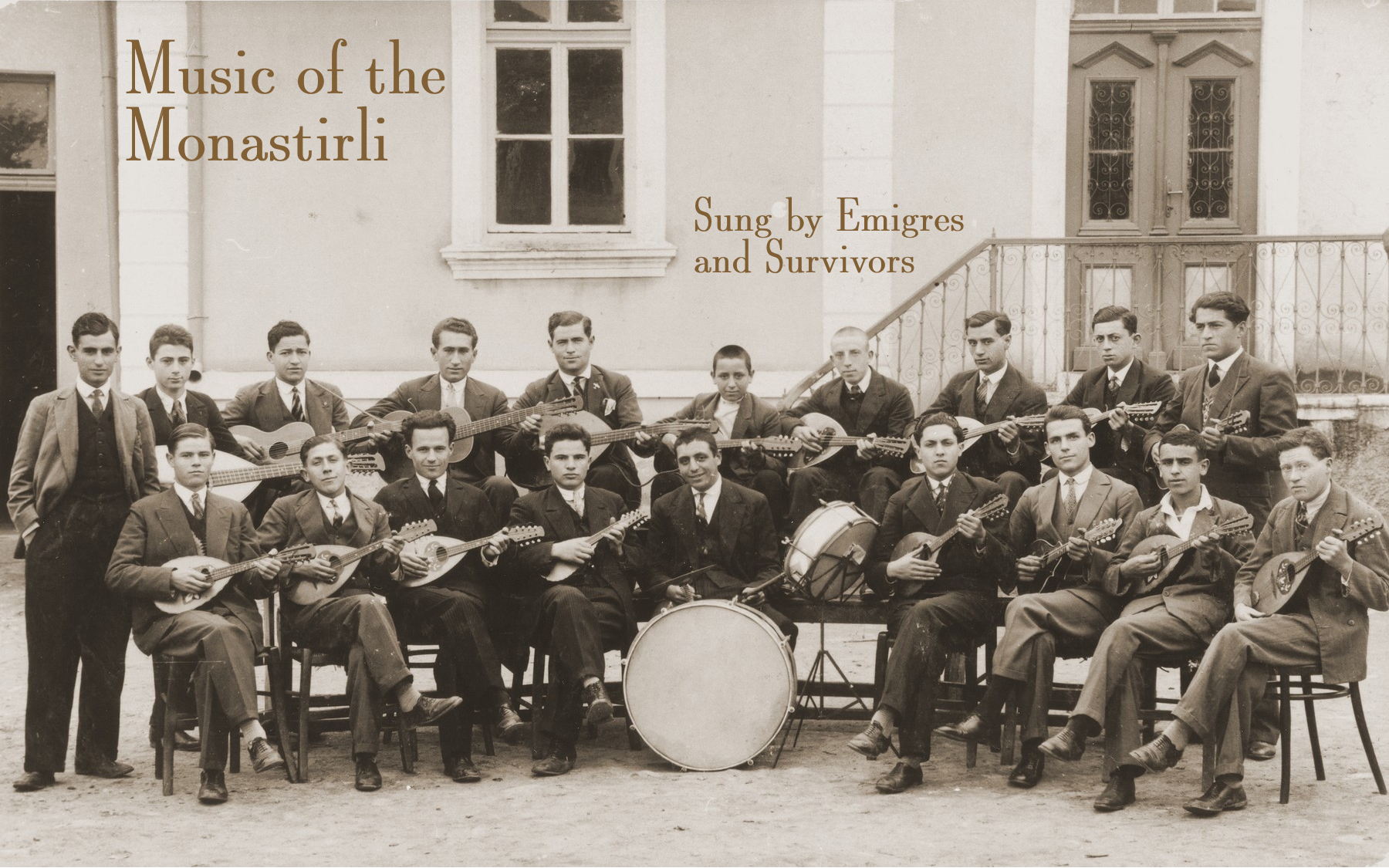
In addition to these multiethnic ensembles, Jewish musicians also formed community-based groups. Known examples, primarily from the interwar period (1918–1939), include a Jewish mandolin orchestra, a Jewish “Maccabi” drum-and-cymbal corps, and a Jewish brass band. These ensembles performed at Zionist events, public religious celebrations, one source describes the revival of spiritual verses on Tu BiShvat, accompanied by an orchestra, in a local concert hall, and at the reception of visiting dignitaries.[7]
Music was equally significant within the home. The earliest documentation of Ladino song in Monastir appears in the 1927 dissertation of linguist Max Luria, who focused on the Monastirli dialect of Judeo-Spanish and transcribed six romances (ballads) sung by his interlocutors.[8] In the 1970s, Luria’s wife, Edna Werfel Luria, deposited his papers at Yeshiva University. Among his unpublished notes were twelve additional ballads—several of them exceedingly rare.[9] After Luria’s work, scholarship on Monastirli Jewish music remained scarce until well after the Holocaust, when a handful of publications in Yugoslavia, Israel, and the United States began to document aspects of the repertoire. Much, however, remains unknown and unpublished.
The Joe Elias Collection
One New York family preserves an unusually rich connection to its Monastirli musical heritage. Joe Elias, a descendant of the Cassorla family of rabbis, devoted his life to recording, documenting, performing, and teaching Sephardic music—first learned from his Monastirli parents, Sarah “Shorty” Elias and Rabbi David Elias. Joe spent years traveling among Sephardic communities worldwide, often making field recordings of elder community members. While his recordings encompass a wide range of Sephardic traditions, he took particular interest in the music of the Monastirli.
Among the reel-to-reel tapes and cassettes he made, many forgotten for more than sixty years, are multiple recordings of first-generation Monastirli immigrants, including a remarkable tape of his mother. In it, Joe encourages Shorty to sing the songs she remembered from her childhood in Monastir, often accompanying her on guitar and joining her vocally. Because most extant Monastirli musical recordings were made by Holocaust survivors, the Elias tapes offer rare insight into Jewish musical life as it existed in the late 1930s and early 1940s. Shorty’s memories reached even further back: her songs preserve a sonic snapshot of Monastirli home life around 1910, just before she emigrated to the United States.
Recorded materials in the playlist are made available to the public by Dan Elias. Digital repair and mastering by Nikhil Wadhwa and Zack Youcha, with guidance from Phil Klum and Elliot Majerczyk.
See also in our website the biographies of Sarah Elias ("Shorty") and Joe Elias.
____________________________________
[1] Armistead, Samuel G. and Silverman, Joseph H. “Rare Judeo-Spanish Ballads from Monastir (Yugoslavia) Collected by Max A. Luria.” The American Sephardi 7-8 (1975): 51-61, quote in p. 52.
[2] Cohen, Mark. The Last Century of a Sephardic Community: The Jews of Monastir, 1839-1943. New York: Foundation for the Advancement of Sephardic Studies and Culture. 2003, p. 11.
[3] Ibid. pp. 2-4.
[4] Küppers-Sonnenberg, Collection 157 “Balkan I”. In Die Wachszylinder des Berliner Phonogramm-Archivs: Textdokumentation und Klangbeispiele, CD-ROM Beilage zum Katalog, ed. Susanne Ziegler. Berlin: Staatliche Museen zu Berlin - Preußischer Kulturbesitz, 2006, p. 416.
[5] Sterjovski, Aleksandar, Bitola: Muzika. Bitola: Consulate of Serbia in the Republic of North Macedonia, 2022, p. 256.
[6] Džimrevski, Borivoje. Čalgiskata tradicija vo Makedonija, Skopje: Makedonska kn., 1985.
[7] Sterjovsky, Bitola, pp. 260-261.
[8] Luria, Max A. A Study of the Monastir Dialect of Judeo-Spanish Based on Oral Material Collected in Monastir, Yugoslavia. New York: Instituto de las Españas en los Estados Unidos, 1930, pp. 415-419.
[9] Armistead and Silverman, “Rare Judeo-Spanish Ballads,” p. 51.